Today, we announced plans for the Medford project, a new commercial development in Medford, Oregon. This marks the company’s ongoing growth and expansion into the Oregon market over recent years.
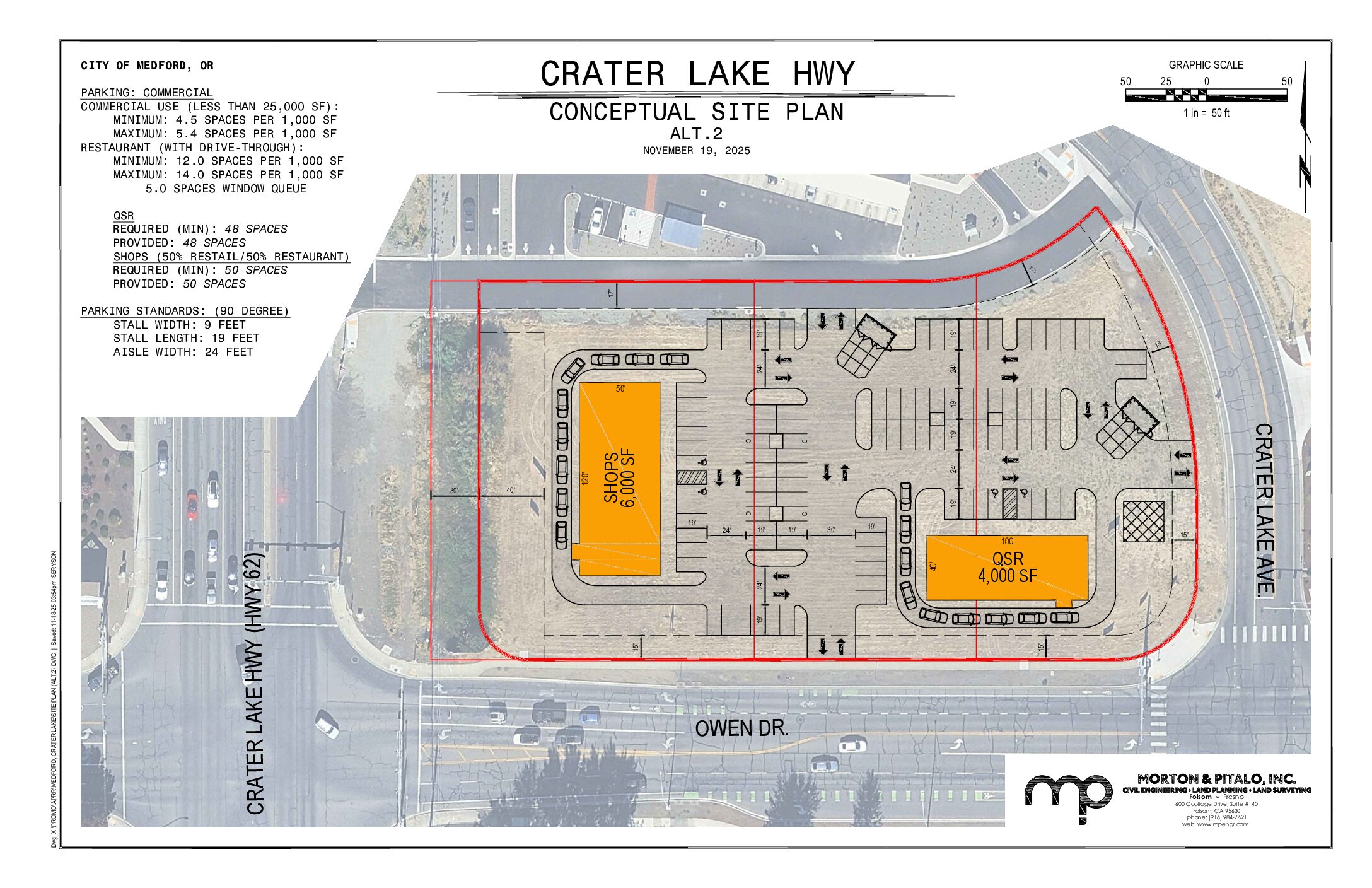
Located along Crater Lake Highway (Highway 62) in the Tower Business Park, the Medford project will feature approximately 10,000 square feet of commercial space, including a 4,000-square-foot quick-service restaurant with a drive-through and a 6,000-square-foot multi-tenant retail building with a drive-thru.
“We’re thrilled to introduce the Medford project to Southern Oregon,” said Akki Patel, CEO of LRE & Co. “This development reflects our commitment to creating quality commercial spaces that serve both businesses and the communities they’re part of. Medford’s strategic location and strong growth trajectory make it an ideal market for LRE & Co’s expansion beyond our traditional Northern California footprint.”
The development will include approximately 98 parking spaces, two drive-through facilities, and pedestrian-friendly design elements throughout the property. The site is strategically positioned along Crater Lake Highway to capitalize on strong traffic while remaining compatible with the surrounding business park.
LRE & Co is currently working through the city’s entitlement process, including Site Plan Review with the Medford Site Plan and Architectural Commission. Tenant announcements and construction timelines will be released as the project advances through the city’s approval process.
The days of shopping centers serving as mere collections of retail storefronts are fading fast. Today’s most successful commercial developments are becoming vibrant community destinations where people come to experience, connect, and gather, not just to shop.
As developers and investors in California’s retail landscape, we’re witnessing a fundamental shift in what draws people out of their homes and into commercial spaces. Understanding this evolution isn’t just about staying relevant; it’s about creating places that genuinely serve the communities we build in.
The Amazon Effect Changed Everything
Let’s address the elephant in the room: e-commerce fundamentally altered retail. When consumers can order virtually anything with a few clicks and have it delivered to their doorstep, the value proposition of physical retail spaces must evolve. We can’t compete on convenience alone anymore.
But here’s what online shopping can’t replicate: the experience of being somewhere. The feeling of discovery. The spontaneity of trying something new. The simple pleasure of sharing a meal with friends or watching your kids play while you grab a coffee. These human experiences became the new currency of successful retail development.
What Makes a Destination?
The most successful retail developments we’ve seen and built share common characteristics that go far beyond traditional tenant mixes. They’re designed on the understanding that people seek experiences, not just transactions.
First, they integrate food and beverage as cornerstones, not afterthoughts. Drive-thru coffee shops like Dutch Bros and Starbucks create daily rituals for communities. Restaurants, ranging from quick-service options like Habit Burger to sit-down establishments, give people reasons to linger, meet friends, and return frequently. Food isn’t just another tenant category; it’s often the primary draw that makes everything else work.
Entertainment and recreation components have become equally essential. Whether it’s a family entertainment center, fitness studios, or outdoor gathering spaces with events and programming, these elements turn a shopping trip into an outing. They give families reasons to spend hours, not minutes, at a development.
Green spaces and outdoor areas designed for community gatherings have proven invaluable. In our Roseville Junction project, we’ve prioritized creating spaces where the community can come together for events, farmers’ markets, or simply to enjoy being outdoors. These aren’t decorative elements; they’re fundamental to the development’s purpose.
The Numbers Tell the Story
Experience-based retail isn’t just a feel-good concept; it’s smart business. When we create destinations rather than shopping centers, we see increased dwell time, which directly correlates with higher spending. A customer who comes for coffee, stays for lunch, then browses a few shops while their kids play generates far more economic activity than someone making a single-purpose shopping trip.
Mixed-use developments also create natural cross-traffic among tenants. Parents who drop off their children at daycare become regular customers at nearby coffee shops. Hotel guests at properties like ours in Roseville explore the surrounding retail and dining options. Office workers on lunch breaks frequent quick-service restaurants. This ecosystem effect makes every tenant more successful.
From an investment perspective, experience-based developments are more resilient. When a retail center is valued for the overall experience rather than any single anchor tenant, it’s better insulated from market shifts. If one restaurant closes, the development’s appeal remains because people come for the destination itself.
Lessons from the Field
Through our work across California and Nevada, we’ve learned that successful experience-based retail requires planning from day one. You can’t simply add a few restaurants to a traditional shopping center and call it experiential. The entire development must be designed as a cohesive destination.
Site planning matters immensely. Wide sidewalks, comfortable outdoor seating, intuitive traffic flow, and ample parking all contribute to whether people perceive a space as welcoming. We’ve found that creating distinct zones, such as a coffee-and-breakfast area separate from evening dining, or family-friendly spaces separate from professional services, helps visitors navigate and discover the development naturally.
Tenant curation is equally critical. We’re not just filling spaces; we’re crafting an experience. The right mix creates synergy, where the whole exceeds the sum of its parts. A great coffee shop next to a daycare center next to a yoga studio creates a morning-routine ecosystem. A brewpub near a family entertainment venue and evening dining options creates a different kind of destination for different dayparts.
Looking Ahead
The trend toward experience-based retail isn’t slowing; it’s accelerating. As younger generations prioritize experiences over possessions and as remote work continues reshaping how people structure their days, demand for well-designed community gathering spaces will only grow.
The developments that will thrive in the coming decades won’t be the ones with the most square footage or the biggest anchor tenants. They’ll be the ones that truly understand why people leave their homes and what they’re seeking when they do. They’ll be places that feel less like shopping centers and more like the heart of a community, because that’s exactly what they are.
For developers, this shift presents both a challenge and an opportunity. It demands more creativity, more careful planning, and a deeper understanding of community needs. But when done right, experience-based retail doesn’t just generate returns; it creates something genuinely valuable for the communities we serve. That’s the kind of development worth building.
In the quick-service restaurant industry, location isn’t just important; it’s everything. I’ve spent years working with brands like Dutch Bros, Starbucks, and Habit Burger, and I can tell you that the difference between a thriving location and an underperforming one often comes down to the science of site selection. Today’s most successful QSR brands don’t rely solely on gut feelings or basic demographics. They use sophisticated analytical frameworks that turn location selection from an art into a precise science.
The Foundation: Traffic Patterns and Accessibility
When evaluating potential drive-thru locations, traffic count is the most fundamental metric, but it’s far from the only consideration. We also look at average daily traffic (ADT) on adjacent roadways, typically seeking locations with 20,000 to 40,000 vehicles per day for most QSR concepts. However, raw numbers tell only part of the story.
Directional flow matters greatly. A site on the “going home” side of a major commuter route typically outperforms an identical location on the opposite side, especially for morning coffee concepts such as Dutch Bros and Starbucks. We analyze morning versus evening traffic patterns, recognizing that a site may see 60% of its traffic during the morning commute and capture a disproportionate share of revenue during those peak hours.
Ingress and egress, how easily customers can enter and exit the property, can make or break a location. The ideal site offers right-in, right-out access at a minimum, with left-turn access being highly desirable. We evaluate sight lines, median breaks, and traffic signal timing. A location that requires customers to make difficult turns or navigate confusing access points will see significant transaction loss, regardless of how strong other metrics appear.
Demographics: Beyond the Basics
While traditional demographics such as population density and household income remain important, modern site selection goes much deeper. For drive-thru concepts, we analyze daytime population, the number of people who work in the trade area versus those who live there. A location near office parks might have low residential density but enormous daytime traffic from employees seeking convenient meal options.
Psychographics are equally crucial. We analyze lifestyle segmentation data to understand consumer behaviors, preferences, and spending patterns. A Habit Burger location performs best in areas where residents value quality ingredients and are willing to pay premium prices for better-burger concepts. Dutch Bros thrives in communities with younger demographics who appreciate the brand’s energetic culture and beverage customization.
Technology now allows us to analyze mobile device data to understand actual movement patterns, dwell times, and cross-shopping behaviors. This reveals where potential customers spend their time, which competing restaurants they visit, and what their daily routines look like.
The Competitive Landscape
Understanding competition requires both macro- and micro-level analysis. We map all QSR locations within a trade area, paying special attention to direct competitors and complementary concepts. A Starbucks location might benefit from proximity to other coffee shops if the area demonstrates sufficient demand, while too many burger concepts in a tight radius could cannibalize a Habit Burger’s potential.
We also assess cannibalization risk for brands with multiple locations. Using sophisticated gravity models, we can predict how a new location might affect existing stores within the brand’s portfolio. The goal isn’t merely to avoid cannibalization but to optimize the network effect, in which multiple locations increase brand awareness and accessibility without significantly affecting individual store performance.
Site-Specific Characteristics
The physical attributes of a property significantly impact operational success. Drive-thru configuration is paramount; we evaluate queue capacity, menu board placement, bypass lane feasibility, and whether the design accommodates mobile order pickup lanes, which have become essential post-pandemic.
Parcel size and shape matter greatly. Most drive-thru concepts require a minimum of 0.5 to 1 acre, with specific frontage requirements. Corner locations often command premiums due to their visibility and accessibility advantages. We assess utility availability, grade and drainage, environmental constraints, and zoning compliance, as any of these factors can derail a project or dramatically inflate development costs.
The Financial Equation
Ultimately, every site selection decision is a financial one. We build detailed pro formas that project revenue based on traffic patterns, demographics, competitive dynamics, and model occupancy costs, development expenses, and operational considerations. The goal is to identify locations where unit economics support strong returns on investment.
Rent as a percentage of sales is a critical metric; most QSR concepts target 6-8% of gross sales for occupancy costs. We also evaluate lease terms, tenant improvement allowances, and exclusivity provisions that protect the brand’s long-term interests.
The science of site selection integrates data analytics, real estate expertise, and operational understanding. When executed properly, it transforms location selection from educated guesswork into a strategic advantage that drives sustainable growth and profitability for quick-service restaurant brands.
At LRE & Co, our team members wear many hats, and few embody that spirit more than Amber Lonski. As a Due Diligence Coordinator, Entitlement Manager, Project Manager, and more, Amber is the organized force that keeps our complex projects on track from concept to completion.
From Healthcare to Real Estate
Amber’s journey to LRE & Co took an unexpected turn. After 15 years in the medical field, including 12 years managing a family practice and three years managing a dermatology office, she found herself craving something different. “While I loved helping people, I felt like I was created for something more,” she reflects.
That “something more” led her to real estate and construction. Since joining LRE & Co. in July 2020, Amber has been fascinated by the building process itself and by how projects evolve from initial concepts into thriving businesses that serve communities.
The Art of Staying Organized
When you’re juggling multiple projects with countless moving parts, organization isn’t just helpful; it’s essential. “I am extremely organized,” Amber says. “The process is not easy. There are multiple steps, and if you miss one, it could cause a major delay. Having things organized helps streamline the process.”
Her typical day involves focusing on one project at a time while remaining ready to pivot. “Multiple fires come up daily, so I work my way through them and keep going,” she explains. It’s this combination of structure and adaptability that makes Amber invaluable to our team.
Finding Reward in the Journey
What keeps Amber passionate about her work? “Creating new businesses and opportunities,” she says without hesitation. “The process is so long from start to finish. It’s rewarding when the business is open and operating. Just to sit back and think, ‘I helped with that,’ is truly amazing.”
Take the Roseville Junction project, for example, which remains active and presents new challenges daily. “You just need to put your head down, breathe, put on your thinking cap, and get through the issues, one at a time,” Amber notes. Her persistence is her superpower: “I stick with things until they’re done.”
Looking Ahead
Amber sees exciting changes on the horizon for the industry. With the rise of online shopping, she believes people are craving more gathering spaces and experiences, a shift that aligns perfectly with LRE & Co.’s vision. “It’s exciting to see what comes next,” she says.
Regarding her future with the company, Amber has ambitious goals: “I would like to partner up at some point and invest in some of our projects. Just having that opportunity would be huge.”
Beyond the Office
When she’s not navigating the complexities of real estate development, you’ll find Amber outdoors, especially now that she has a new companion. Her pug, Benson Boone, who turns one on Christmas Day, keeps her active and exploring new places. “I enjoy taking him to new places and seeing his excitement,” she says.
Her perfect weekend? Home improvement projects (she’s completely renovated her house), family and friend gatherings, and trips to the dog park. She’s also a dedicated practitioner of hiking, yoga, and meditation, “needed in this line of work,” she adds with a laugh.
Amber’s go-to beverage? An iced double-shot chai tea latte. She describes herself as someone who “dabbles in both worlds” when it comes to being a morning person or a night owl—fitting for someone who needs to be ready for anything.
Words to Work By
When asked about the best advice she’s ever received, Amber offers wisdom that serves her well in the fast-paced world of development: “Breathe and think before you react.”
For those just starting their careers, her guidance is simple: “Open your ears and learn as much as you can.”
And perhaps most importantly, she’s learned from the LRE & Co team that flexibility is key: “The process can start with one plan and end with something entirely different. You need to be willing to adapt to the constant changes in this field.”
Making an Impact
What makes LRE & Co stand out? According to Amber, it’s our willingness to tackle ambitious projects and phase them strategically. “We are not afraid to tackle the big projects,” she says proudly.
As someone working “in the trenches,” as she puts it, Amber knows her role is crucial to whether projects materialize and, ultimately, to LRE & Co’s mission of creating economic opportunities and positive community impact.
Every property is someone’s home, someone’s business, someone’s future.
Asa part of our series about “How A Single Choice Can Redefine A Leadership Journey”, we had the pleasure of interviewing Akki Patel, the founder and leader of LRE & Co., a family-owned organization established in 1999 that specializes in real estate development, construction, and hospitality. Beginning his entrepreneurial journey at 20 with his first restaurant, Patel had built a diverse business empire, opening and operating more than 300 restaurants while managing over 850 establishments across California and northern Nevada.
Patel holds an undergraduate degree in accounting from the University of San Diego and has experience in the venture capital industry. He is a member of the Young Presidents’ Organization and serves on the advisory boards of several companies and nonprofits. His leadership philosophy emphasizes creating economic opportunities, delivering stakeholder value, and fostering a diverse, dynamic workforce dedicated to excellence.
Thank you so much for joining us in this interview series. Before we dive into our discussion, our readers would love to “get to know you” a bit better. Can you share with us the backstory about what brought you to your specific career path?
I grew up watching my family navigate the complexities of business and real estate, which sparked early curiosity about how value is created and maintained. But what truly drew me to this path wasn’t just the transactions — it was the understanding that real estate, at its core, is about people and communities. Every property is someone’s home, someone’s business, someone’s future.
I began my career in finance, which taught me discipline and analytical rigor. However, I felt most energized when working on deals that involved a human element — where you could see the direct impact on tenants, partners, and communities. That inspired me to start LRE & Co, where we aimed to build something that combined strong financial performance with genuine relationships. I wanted to create a company where doing right by people wasn’t just a slogan but the foundation of everything we do.
Can you share the most interesting story that happened to you since you started your career?
In 2019, we acquired a company that, by traditional metrics, we probably overpaid for. Then 2020 came, and like so many businesses, it took a hit. By late 2021, we sold it. On a spreadsheet, you’d call that a loss. But here’s what the numbers didn’t show: that acquisition brought us two incredible people who are now essential to LRE.
These weren’t just employees joining a team; they transformed our entire culture. The way they show up for partners, communicate with lenders and tenants, and handle on-site tasks raised our standards across the board. Today, they’re not just colleagues; they’re family. They embody the friendship, loyalty, and work ethic that’s easy to talk about but hard to find.
Looking back, I call it an “accidental acquihire.” We didn’t plan it that way, but we gained something far more valuable than the original business model promised. It taught me that if you judge a deal solely on the spreadsheet, you’ll miss the compounding value of the right people. That’s the kind of return that keeps paying dividends.
What do you think makes your company stand out? Can you share a story?
LRE stands out because we truly believe that the best return comes from the people, not just the people we serve, but also those we work with. We’ve built a culture where relationships aren’t transactional; they are foundational.
The story I just shared about the 2019 acquisition clearly illustrates this. We could have seen that deal as a financial mistake, accepted the loss, and moved on with a cynical attitude. Instead, we understood what really mattered: two outstanding individuals who improved everything we do. That experience strengthened our belief that talent and culture grow over time in ways that balance sheets can’t predict.
We support our partners, tenants, and team with consistent dedication. We innovate not just in deals, but also in building trust and providing value. That’s what makes us different — we’re playing the long game, and we’re counting on people every time.
You are a successful business leader. Which three character traits do you think were most instrumental to your success? Can you please share a story or example for each?
1. Long-term thinking over short-term wins The 2019 acquisition serves as a perfect example. When the business faced difficulties and we sold it in 2021, the immediate financial results didn’t look promising. However, I never judged success based on that single sale. The long-term benefit — two outstanding team members who continue to create value — far exceeded the short-term profit and loss statement. I’ve discovered that the best decisions often take years to fully unfold.
2. Conviction in people over assets Throughout my career, I’ve seen deals succeed or fail depending on the people involved. When we evaluate opportunities, we spend as much time assessing cultural fit and team capability as we do analyzing the numbers. In real estate, you can have the best property in the best location, but without the right people managing it, building relationships with tenants, and solving problems creatively, it’s just another building. Our success comes from consistently prioritizing character and competence over flashy assets.
3. Humility to learn from every outcome Not every deal turns out precisely as planned; that’s just reality. What matters is what you learn. The 2019 acquisition taught me that “failure” and “success” aren’t always binary. We could have been rigid about our original thesis, but instead, we stayed open to discovering unexpected value. That humility to adapt and to see beyond our initial assumptions has been crucial. It keeps us innovative and honest about what really matters.
Ok, thank you for that. Let’s now jump to the primary focus of our interview. What was the pivotal decision that transformed your approach to leadership, and what prompted you to make it?
The key decision happened after my 2019–2021 experience. I realized I needed to fundamentally change how I define success — not just for individual deals, but for LRE as a whole. The message was simple but powerful: two people I deeply respect are thriving at our company despite the “failed” transaction that brought them here.
I decided to stop leading primarily through financial metrics and instead focus on people and culture first. That doesn’t mean we ignore the numbers — we’re strict about performance — but it means we make decisions asking: “Who does this bring us closer to? Who does this help us become? What does this build beyond the immediate transaction?”
This wasn’t about becoming soft or idealistic. It was about realizing that sustainable, compounding success comes from attracting, keeping, and empowering exceptional people. Once I made that shift, everything changed — from how we structure deals to how we handle setbacks and how we measure our progress.
How did this single choice impact your personal growth and your view on what it means to lead?
This choice freed me from the anxiety of perfection. When you’re solely focused on metrics, every deal that doesn’t meet projections feels like a personal failure. But when you lead with a people-first approach, you develop a different perspective: you see opportunities for growth, learning, and relationship-building even in challenging situations.
Personally, it made me a better listener and observer. I started paying more attention to how people communicate, collaborate, and handle pressure. I became less interested in being the smartest person in the room and more focused on creating an environment where smart people thrive.
My view on leadership shifted from “making the right calls” to “building the right culture.” Authentic leadership isn’t about having all the answers — it’s about assembling a team that together has better answers than you ever could alone. It’s about creating environments where people bring their best selves to work and truly feel valued. That’s much more rewarding than just hitting quarterly targets.
What were some of the immediate and long-term effects of this decision on your team or organization?
Immediate effects: Our retention rates improved significantly. People felt recognized and appreciated beyond their productivity. Decision-making grew more collaborative. Team members understood their perspectives mattered, not just their execution. We began attracting diverse candidates — people motivated by culture and mission, not just pay. Trust levels rose throughout the organization. When people see you’re personally invested in them, they’re more willing to take risks and openly discuss challenges.
Long-term effects: Our reputation in the market has shifted. Partners and tenants began choosing us not just for our capabilities, but also for how we show up and treat people. Innovation accelerates when people feel secure and valued, making them more creative and willing to challenge the status quo. Resilience has improved. We’ve weathered market fluctuations and unexpected challenges better because our team has strong loyalty and commitment to one another. Our performance metrics actually improved. Paradoxically, by focusing less obsessively on the numbers and more on our people, our financial results strengthened because we were building something sustainable. The compound effect has been remarkable. The two team members from the 2019 acquisition have mentored others, elevated standards, and helped us attract even more talented people. It fosters a virtuous cycle.
How did you handle any uncertainty or doubt while making this critical choice?
Honestly, I experienced moments of doubt. The business world constantly proves that financial performance is king, and when you discuss culture and people-first leadership, some people see you as naïve or soft.
I managed the uncertainty by focusing on what I could observe and measure differently. I watched how those two team members from the acquisition transformed our operations. I saw morale improve. I noticed that our best people were staying longer, and our recruitment was becoming easier. These tangible signs gave me confidence that this wasn’t just feel-good philosophy — it was practical and effective.
I also relied on trusted advisors who had built sustainable, people-focused organizations. Their experiences confirmed that you don’t have to choose between a strong culture and strong performance — in fact, the two support each other.
When doubt arose, I reminded myself: the old method provided predictable results. This new method was delivering compounding returns and greater fulfillment. That trade-off felt worth the uncertainty.
What lessons did you learn from this decision that you continue to apply in your leadership today?
Lesson 1: Speed is essential, but direction is more crucial. That experience taught me that moving quickly to attract talent — even through an unconventional route — can cut years off the recruiting and development process. However, it only works if you’re clear about your culture and values. I now focus on cultural fit and character as much as capability in every hiring decision.
Lesson 2: The “cost” of investing in people is often undervalued. We paid a premium for that company and sold it at a loss. Traditional analysis says we failed. But the actual return comes every day and raises our standards. I’ve learned to look beyond immediate costs and see the long-term growth potential of the right people.
Lesson 3: Transparency and honesty build trust. When we sold that business, we were open with our team about what happened and what we learned. That vulnerability strengthened relationships rather than weakening them. I continue to lead with transparency because it fosters the trust needed for people to do their best work.
Lesson 4: Culture gives you a competitive edge. In our industry, many firms have access to similar capital, deals, and expertise. What sets us apart is how we collaborate, treat partners, and solve problems. I defend and nurture our culture as passionately as I protect our financials.
Ok super. Here is the main question of our interview. What are your “Five Things You Need to be a Transformational Leader”? If you can, please share a story or an example for each.
1 . Value people over assets The 2019 acquisition clarified this for me. We purchased a business that didn’t succeed financially, but gained two people who transformed our company. Transformational leaders recognize that talent, character, and culture create lasting value in ways that products, technology, or even real estate alone cannot. Now, every major decision I make starts with: “How does this affect our people? Who does this bring us closer to?” When you consistently focus on people, you build something that can withstand any market condition.
2. Embrace speed and adaptability over perfect planning That same acquisition taught me about speed. In hindsight, it was an “accidental acquihire” that condensed a year’s worth of recruitment and training into a single decision. We didn’t execute flawlessly, but we acted with conviction. Transformational leaders don’t wait for perfect information — they make informed bets and adapt quickly. The ability to move fast, learn, and adjust outweighs having a flawless five-year plan. Markets change, opportunities vanish, and talent is hired elsewhere while you’re still analyzing.
3. Lead with transparency and authenticity When we sold that business in 2021, I could have ignored it or spun it in a positive light. Instead, I was honest with our team about what happened and what we learned. That honesty strengthened trust and showed that it’s okay to take calculated risks that don’t always work out as planned. Transformational leaders foster environments where people can be honest about challenges, learn from setbacks, and innovate without fear. Authenticity isn’t a weakness — it’s the foundation of true influence.
4. Measure success by cultural compound interest, not just quarterly returns Great people improve everything: decision-making, managing pressure, and building trust with partners and tenants. That cultural boost pays off project after project, year after year. I’ve learned to evaluate decisions by asking: “Does this strengthen our culture? Will this grow stronger over time?” Sometimes that means passing on a lucrative deal that would compromise our values or investing in team development that doesn’t show immediate ROI. Transformational leaders play the long game and trust that a strong culture yields compounding returns.
5. Maintain conviction in your values during uncertainty The period from 2019 to 2021 tested my conviction. The business faced struggles and pandemic challenges and eventually sold at a loss. There were moments when I doubted the decision. But I held onto my core belief: we’re building something bigger than any single transaction. Those two team members showed that staying true to our values — even when the spreadsheet suggests otherwise — was the right decision. Transformational leaders don’t abandon their principles when times get tough; they double down on what matters most: their people, their culture, and their mission.
Were there any unexpected challenges or rewards that emerged from this choice?
Unexpected challenges: The biggest challenge was patience within the organization. When shifting to a people-first culture, some results take time to appear. In the months immediately after deciding to focus on culture, we had to resist pressure to deliver quick financial gains — discussions with stakeholders questioned whether we were being too soft or losing our competitive advantage. Staying firm during that time required discipline.
Another challenge was hiring. We became more selective, which sometimes meant leaving positions open longer than we would have liked. When you’re committed to cultural fit and character, you can’t just fill seats; you have to find the right people. That patience was challenging but ultimately necessary.
Unexpected rewards: The rewards exceeded my expectations. First, our market reputation changed. We started attracting inbound interest from talented people who wanted to work in our culture. That dramatically reduced recruiting costs and improved quality.
Second, our relationships with partners and tenants grew stronger. When your team genuinely cares and acts with integrity, people take notice. We’ve secured deals and kept tenants primarily because of how we treat others, not just because of our pricing or capabilities.
Third, personal fulfillment. Creating a company where people thrive and feel appreciated is far more rewarding than simply maximizing profits. Going to work and seeing people you genuinely care about doing their best, that’s a reward I didn’t fully expect but now can’t imagine living without.
Finally, those two team members from the acquisition have become informal ambassadors of our culture, helping new people onboard and modeling what we value. They’ve multiplied their impact far beyond what we could have predicted.
How has this decision influenced the advice or guidance you offer to emerging leaders?
I tell emerging leaders: Don’t wait for permission to lead with your values. Earlier in my career, I needed to hit certain milestones or achieve a certain status before I could lead the way I wanted. The 2019 acquisition taught me that you can start building the culture and organization you believe in right now, regardless of your title or resources.
Here’s the specific guidance I share: 1. Redefine success early. Don’t let others dictate what metrics matter. If people and culture are essential to you, make them explicit priorities from day one, not something you’ll “get to later.”
2. Trust your observations over conventional wisdom. I saw two incredible people thriving despite a “failed” transaction. That observation was more valuable than any business school framework. Pay attention to what’s working, not just what should work in theory.
3. Price is just one part of the deal. Whether you’re evaluating an acquisition, a partnership, or a hire, look beyond the immediate cost. Ask about cultural contribution, long-term potential, and intangible value. Some of the best investments look overpriced at first.
4. Build your team like your reputation depends on it — because it does. Every person you bring into your organization shapes your culture and your future. Be rigorous and patient about cultural fit. One wrong hire can set you back more than an empty seat.
5. Be willing to look foolish in the short term for long-term gain. Our 2019 acquisition looked like a mistake for a while. But I knew what we’d gained. Don’t let short-term critics deter you from building something sustainable.
The emerging leaders who resonate with this approach are building the companies I’m excited to see in ten years.
You are a person of great influence. If you could start a movement that would bring the most amount of good to the most amount of people, what would that be? You never know what your idea can trigger. 🙂
I’d start a movement called “Return on People” that fundamentally reframes how business success is measured and valued.
Here’s the concept: Companies would adopt a dual reporting framework that measures and publicly shares not just financial performance, but also people performance — retention rates, internal mobility, employee growth trajectories, cultural health indicators, and community impact. The goal would be to make “people returns” as important as financial returns in how we evaluate business success.
Imagine if every company had to answer: How many people did you develop this year? How many careers did you advance? How did your employees’ lives improve? How strong is your culture? What’s your compounding people value?
This would create several ripple effects: For companies, It would redirect competition toward creating better workplaces rather than simply maximizing productivity. Companies would focus on investing in people development because it’s publicly recognized and appreciated.
For employees: People would have better information about where to work. They could compare companies not just on salary, but on genuine investment in people.
For society: As more companies compete in people development, we will see stronger communities, improved mental health, increased economic mobility, and more sustainable business practices.
For capitalism itself: We will demonstrate that you don’t need to choose between profits and people — actually, investing in people leads to better long-term financial results.
The movement would start with companies voluntarily adopting this framework, sharing best practices, and building a community around a people-first business approach. Over time, it could influence investors, boards, and eventually policy.
I genuinely believe the future of business is human-centered, and this movement would accelerate that transition. The companies that win in the long run will be the ones that understand: the best return is the people.
How can our readers further follow your work online?
The best way to follow our work and philosophy is through:
LRE & Co. website: We share updates about our projects, team, and approach to real estate investment and management. https://lrecompanies.com/
I’m also always open to conversations with people building people-first organizations or emerging leaders who want to talk about balancing performance with culture. Feel free to reach out directly through LinkedIn — I genuinely enjoy those connections.
Thank you for the time you spent sharing these fantastic insights. We wish you only continued success in your great work!
Thank you for the thoughtful questions. This conversation reinforced why I love what we’re building at LRE. If even one reader walks away thinking differently about how they value people in their organization, this will have been time well spent.
I appreciate the opportunity to share our story, including the messy, unexpected parts. That’s where the real learning happens. I wish you and your readers continued success — and remember: bet on people. That’s the return that endures.
In my previous article, I analyzed where California’s hospitality market stood in 2025—stable fundamentals overshadowed by rising costs and selective distress. Now, as we look toward 2026, the industry faces what one analyst called a “recalibration,” a year that requires strategic discipline over optimistic expansion.
At LRE & Co, we focus on making long-term capital decisions. That means we can’t afford to rely on wishful thinking. Here’s what the data shows about 2026 and what it means for anyone investing in California hospitality.
The Forecasts Tell a Sobering Story
National RevPAR is projected to decrease by 0.2% in 2025 before increasing by 0.9% in 2026—modest growth that barely exceeds inflation. Occupancy will fall from 63% in 2024 to 62.5% in 2025 and 62.3% in 2026, indicating continued softness even as ADR rises slightly.
This isn’t a collapse. It’s stagnation—the kind that tests whether your operations can still generate profit when tailwinds fade.
California faces additional pressures. Visit California forecasts 2.2% revenue growth in non-gateway markets compared to 1.8% in gateway regions, suggesting that secondary markets might outperform traditional urban centers. San Francisco’s Super Bowl and FIFA World Cup matches in both Los Angeles and San Francisco should boost demand temporarily, but these are one-time events, not long-term improvements.
The harsh truth? The latest forecast shows the first yearly decline in U.S. RevPAR since 2020, and ADR growth still lags behind inflation, squeezing margins everywhere.
The Two-Speed Recovery Accelerates
The bifurcation I discussed in 2025 isn’t closing—it’s widening. Luxury hotels saw a 5.3% RevPAR increase through August 2025, while the economy segment fell 1.8%. Only luxury and upper-upscale chains experienced positive RevPAR growth.
This reflects economic reality. Higher-income households continue to spend confidently on premium experiences, while middle- and lower-income consumers, facing higher credit card debt and depleted savings, cut back or travel less.
For California specifically, this presents both opportunities and risks. Luxury properties in Napa, Carmel, and coastal destinations can charge premium rates. However, midscale properties that rely on budget-conscious leisure travelers face growing competition from vacation rentals and other alternative accommodations.
The middle is getting squeezed, and 2026 won’t provide relief.
AI Moves from Buzzword to Business Imperative
89% of hoteliers plan to adopt new AI applications in 2026, and there’s a good reason. AI-driven revenue management now adjusts rates dynamically based on booking pace, competitor pricing, local events, and weather patterns. AI deployment in hospitality call centers has reduced call abandonment rates by 6-8% and increased reservation conversion by 25-35%.
But AI’s most significant impact comes from improving operational efficiency. Predictive maintenance helps reduce emergency repairs. Innovative HVAC systems enhance energy use based on occupancy forecasts. AI-powered staffing models match labor to actual demand, lowering overstaffing during slow periods.
For California operators struggling with high labor costs, this technology isn’t optional—it’s essential for survival. Properties that implement AI effectively will achieve higher margins than competitors still using manual systems.
The caveat? Implementation demands investment and expertise. Hotels that rush into AI without proper data infrastructure or staff training will waste capital without seeing returns.
Experience and Personalization Become Table Stakes
Personalization will be the key factor in how hospitality brands build loyalty and differentiate themselves in 2026. It’s not just about remembering guest names—it’s about leveraging data to provide exactly what each guest values at the perfect moment.
Static rate plans will disappear, as hotels begin selling experiences from sunrise breakfasts to private yoga sessions, transforming what makes a hotel unique into bookable moments. The line between room rates and experience packages is becoming less clear.
For California properties, this aligns with their natural advantages. Wine country properties can offer curated tastings. Coastal hotels can bundle surf lessons or marine tours. Urban properties can partner with local restaurants, cultural institutions, and entertainment venues.
The key is execution. Creating compelling experiences requires operational capacity, not just marketing creativity. Half-implemented programs that disappoint guests are worse than no program at all.
The Supply Challenge Intensifies
After years of limited growth, new supply is now speeding up. U.S. markets are expected to expand by up to 1.8% in 2026, with 928 new projects and around 101,796 rooms. As supply increases, it may outpace still-delicate demand, possibly leading to lower occupancy rates in certain segments and locations.
California markets experience uneven supply impacts. Los Angeles has limited new construction outside major projects. San Diego continues building, especially in extended-stay segments. Secondary markets like Sacramento and Fresno see moderate development as developers focus on affordability trends.
For existing operators, this means that pricing power declines in markets where new supply is significant. For investors, it presents acquisition opportunities as older properties struggle to compete with the latest amenities and face Property Improvement Plan requirements they can’t afford.
The Financial Reality: Debt, PIPs, and Distress
The hotel sector faces a $48 billion CMBS maturity wave in 2025-2026, with many borrowers facing debt costs of 6.25% to 7% compared to original rates of 3% to 4.5%—a 40% increase that many properties can’t absorb.
Combined with brand-mandated PIPs costing $35,000 to $40,000 per key for mid-market properties, the financial pressure is intense. As of August 2025, hotel delinquency reached 7.29%, and distressed sales are increasing.
For well-capitalized buyers, 2026 offers acquisition opportunities. Distressed owners dealing with refinancing issues and PIP compliance will sell at prices that benefit those with patient capital and operational expertise.
But this requires discipline. Not every distressed asset presents an opportunity—some properties can’t produce enough NOI regardless of ownership. The key is recognizing assets where operational improvements, modest capital investment, and market positioning lead to acceptable returns.
What Works in 2026: The Strategic Playbook
Based on industry forecasts and our development experience, here’s what succeeds:
Luxury and experience-driven properties continue to outperform. Properties delivering memorable experiences justify premium rates even when occupancy softens.
Secondary market positioning offers growth. Non-gateway California markets forecast stronger 2.2% revenue growth versus 1.8% in gateway regions, suggesting opportunity in places like the Inland Empire, the Central Valley, and emerging wine regions.
Extended-stay segments show resilience. Business travelers and displaced residents value apartment-style amenities, particularly in markets with limited residential inventory.
Group and corporate focus provides stability. Higher-priced hotels will benefit from robust group travel demand, especially in the second half of 2026, when significant events create concentrated demand.
Technology-enabled operations improve margins. Properties leveraging AI for revenue management, staffing optimization, and guest personalization operate more efficiently than competitors.
California’s Specific Challenges
The state’s structural challenges—high operating costs, regulatory complexity, and elevated minimum wage—continue into 2026. San Diego’s potential rise to a $25-per-hour minimum wage for hotels would further squeeze profit margins.
International travel recovery remains sluggish, with inbound visitors making up less than 20% of California hotel demand, down from nearly 25% before the pandemic. This continues to hinder luxury urban hotels that rely on international guests.
But California maintains its advantages: major events like the Super Bowl and FIFA World Cup, unparalleled attractions, and a concentration of high-income households willing to spend on premium experiences. Success requires accepting that California demands top-tier execution—you can’t operate mediocre properties profitably in this cost environment.
The Investor Perspective
The bid-ask spread is still wide compared to 24 months ago, but with RevPAR stabilizing, 2026 might present more opportunities for dealmakers with confidence and strong balance sheets.
Transaction volume is expected to rise, mainly due to distressed sales as overleveraged owners exit. Trophy assets continue to attract capital, but most deals require careful underwriting that considers actual operating costs, realistic stabilization timelines, and honest assessments of competitive positioning.
For LRE & Co, this means being selective. We’re focusing on secondary markets with demographic tailwinds, properties that need capital investment and offer genuine differentiation, and situations where operational improvements can drive NOI growth that offsets higher interest costs.
The Bottom Line
California hospitality in 2026 isn’t about riding recovery momentum; there isn’t any. It’s about operational excellence, strategic positioning, and disciplined capital deployment in a market that rewards precision.
The bifurcated recovery persists. Luxury continues to thrive. The economy faces challenges. Midscale sectors are getting squeezed. Technology has become essential. Experiences matter more than amenities. Supply growth surpasses demand growth.
Success depends on accepting this reality instead of waiting for market conditions to get better. The properties and operators that succeed in 2026 will be those who adjust their strategies to current market trends, invest in technology and experiences that set them apart, and stay financially disciplined while competitors focus on growth.
It won’t be the easiest year the industry has encountered. But for those willing to execute precisely, keep realistic expectations, and deploy capital wisely, 2026 presents opportunities that simpler markets don’t offer.
The hospitality market no longer rewards optimism; it rewards competence. And honestly, that’s exactly how it should be.
At LRE & Co, we develop hospitality properties, as well as retail and mixed-use spaces, throughout Northern California. When you’re in the business of creating places where people stay, you learn to interpret the market not through press releases but by understanding what truly works in practice.
The California hospitality market in 2025 tells a nuanced story—one that’s neither the doom-and-gloom narrative some headlines suggest nor the triumphant recovery others celebrate. It’s more complex than that, and understanding this complexity is essential for anyone investing capital in this space.
The California Reality: Strong Fundamentals, Stubborn Challenges
California’s hotel industry market size reached $37 billion in 2025, growing at an average annual rate of 12.4% since 2020. That sounds impressive until you look at what’s really happening underneath those numbers.
California hotel sales volume fell by 15.3% in 2024 compared to 2023, while the number of individual sales decreased by 7.5%. More worrying, foreclosure activity surged significantly—from 53 notices of default filed in December 2023 to 86 in December 2024. The gap between buyer and seller expectations remains large, with many sellers still hoping for 2021-2022 pricing that today’s market cannot support.
This gap presents opportunities for well-funded buyers willing to wait, but it also indicates real struggles in parts of the market. Hotels that succeeded during the post-pandemic boom are finding that 2025 requires different approaches than 2022 did.
Regional Performance: The Tale of Three Markets
Southern California’s three primary markets—San Diego, Los Angeles, and Orange County—each tell distinct stories.
San Diego leads the state with a 12-month average occupancy of 73.8% through June 2025, consistently outperforming other California markets. RevPAR grew 2.4%, exceeding the national average of 1.5%. The market benefits from diverse demand generators: leisure attractions such as the San Diego Zoo and beaches, major conventions including Comic-Con with 135,000+ attendees, and strong weekday business from the life sciences, healthcare, and military sectors.
But even San Diego faces challenges. The large 1,600-room Gaylord Pacific Resort opened in May 2025, adding significant new supply. Leisure travel, which accounts for about 55% of room nights, experienced modest declines during the summer as budget-conscious travelers chose vacation rentals or alternative destinations.
Los Angeles saw RevPAR grow 5% in Q1 2025, driven in part by displaced residents and recovery teams from January’s wildfires. While the fires didn’t damage hotels or major attractions, this created unusual demand that may not persist. Inbound international travel remains below pre-pandemic levels, accounting for under 20% of hotel room demand, compared with nearly 25% in 2019.
Orange County has effectively stopped new construction due to high costs, creating supply constraints that support existing properties but limit market growth.
The Western States: Las Vegas Sets Records, Arizona Builds Momentum
Las Vegas continues its impressive run. The market welcomed 40.8 million visitors in 2024, and while occupancy at 83.6% still falls short of pre-pandemic levels, ADR reached $193.16, and RevPAR hit $161.48—record figures for the third year in a row. Gaming revenue for Clark County totaled $13.5 billion, setting another annual record.
What Vegas shows is that experience-driven hospitality can charge premium rates even when occupancy isn’t fully back. The new developments, attractions, and events—like the Sphere and major sporting events—generate demand that supports higher prices.
Arizona’s hospitality industry is flourishing in ways that deserve more recognition. The state predicts nearly 6,000 new hospitality and entertainment jobs will be created by 2036. Tucson’s trailing 12-month RevPAR increased impressively by 7.9%, with ADR rising 6.3%. Arizona’s favorable business environment, expanding population, and major events make it an increasingly appealing alternative to California’s higher costs.
The Cost Crisis: Wages, PIPs, and Margin Compression
Here’s the uncomfortable truth about California hospitality in 2025: operating costs are rising faster than revenue.
San Diego faces a potential increase in the hotel minimum wage to $25 an hour if pending legislation passes. Property Improvement Plans (PIPs), required by franchisors, now cost between $35,000 and $40,000 per room for mid-market, select-service hotels—a 30% to 40% rise from pre-COVID levels. These aren’t optional expenses; they are requirements for maintaining franchise agreements.
Meanwhile, increases in labor, insurance, utilities, and property tax costs are outpacing RevPAR growth across the industry, leading to shrinking margins for operators. Hospitality is unique among commercial real estate asset classes in requiring existing owners to reinvest millions of dollars into properties to maintain current NOI levels.
In California specifically, this cost burden, along with the state’s regulatory complexity, makes development and operations more challenging than in neighboring states. It’s not insurmountable, but it requires disciplined underwriting and realistic pro formas.
The Transaction Market: Waiting Game Continues
Hotel transaction activity has remained subdued throughout 2025. In the past 12 months, hotel transaction volume declined nearly 75%. Since Los Angeles’s “Mansion Tax” took effect in April 2023, only four hotels in the LA market traded for more than $20 million, two of which were tax-exempt.
This creates a standoff. Sellers remember peak pricing from 2021-2022. Buyers see compressed margins, rising costs, and uncertain demand. CoStar Analytics forecasts a 75 to 125 basis-point increase in cap rates over the next 12 months, making conditions more attractive for buyers than for sellers.
For developers and investors, this indicates that 2025-2026 might offer acquisition opportunities—especially for distressed assets or properties where owners can’t meet PIP requirements—but only if you’re prepared to invest capital in repositioning and maintain realistic expectations about stabilized returns.
What’s Actually Working: The 2025 Playbook
Based on our experience and market observation, here’s what performs in 2025’s California hospitality market:
The luxury and upper-upscale segments show resilience. Premium properties that deliver exceptional experiences continue commanding strong rates. Luxury RevPAR is up 2.9% year-to-date nationally, significantly outperforming other segments.
Experience-driven properties outperform commodity hotels. Wellness programs, unique F&B offerings, and memorable amenities create differentiation that justifies premium pricing. Two-thirds of people worldwide now expect high-quality, personalized, and wellness-enhancing experiences to be integrated into every space they engage with.
Suburban and resort locations benefit from sustained leisure demand. While urban business travel recovery remains incomplete, drive-to destinations and vacation properties continue to perform steadily.
Markets with diverse demand generators weather volatility better. San Diego succeeds because it balances leisure, group, corporate, and military segments. Properties dependent on single-demand sources face a higher risk.
Technology-enabled operations improve margins. AI-driven revenue management, contactless services, and operational automation help offset rising labor costs. The hospitality industry is rapidly adopting these tools out of necessity, not preference.
Looking Ahead: Cautious Optimism with Eyes Wide Open
California’s hospitality fundamentals remain stable, with low vacancy rates and steady—if modest—rent growth. Visit California forecasts stronger performance outside gateway markets, with 2.2% revenue growth compared to 1.8% in gateway regions. Significant events in 2026—San Francisco hosting the Super Bowl, Los Angeles and San Francisco hosting FIFA World Cup matches—are expected to boost demand.
But the industry faces a “two-speed recovery,” with luxury and upscale properties thriving while midscale and economy segments struggle. This bifurcation will likely persist through 2026, creating both opportunities and risks depending on your market position.
At LRE & Co, we’re approaching California hospitality with measured optimism. The market isn’t broken, but it’s demanding. Success requires:
Disciplined underwriting that reflects actual operating costs, not pre-pandemic assumptions
Experience-focused positioning that gives guests reasons to choose you over alternatives
Operational excellence because margins for error have vanished
Realistic timelines for both development and stabilization
The developers and operators who succeed in 2025 are those who’ve adjusted their strategies to current realities instead of waiting for yesterday’s market to return. They’ve accepted that premium markets require premium execution, and they have built teams and systems equipped to deliver it.
California hospitality isn’t easy in 2025, but for those willing to do the hard work, invest in quality, and execute with discipline, opportunity still exists. You have to earn it more than you did a few years ago.
Earlier this year, I wrote about Mayor Daniel Lurie’s innovative approach to city leadership, as a problem-solver who spent twenty years delivering results before entering politics. Now, nine months into his term, we’re seeing early signs that his action-driven style is making a difference in San Francisco’s recovery.
The story about San Francisco has mostly been negative for years. Empty offices. Struggling retail. Safety concerns. Bureaucratic gridlock. These issues are real and far from resolved. However, something is starting to shift, and as someone involved in projects across Northern California, I observe these changes with cautious optimism.
The Numbers Tell a Story
Let’s focus on what’s measurable. Muni Metro ridership has risen to about 60% of pre-pandemic levels, and office attendance has reached roughly 52%. While still below our target, it is trending in the right direction.
The apartment vacancy rate has fallen to 5.1% as of Q2 2025, the lowest in over a decade. Vacancy reached nearly 10-11% during the peak of urban out-migration in 2020. The current rate is below the 2019 pre-pandemic level, showing that more people are choosing to live in San Francisco again.
In March 2025, nearly 120 new restaurants and bars opened in the city. That’s not a sign of a declining downtown; that’s entrepreneurs investing their capital, demonstrating that San Francisco’s future is worth betting on.
Private Capital Steps Up
One of Mayor Lurie’s key efforts has been securing support from the private sector. The Downtown Development Corporation, a coalition formed this year with the mayor’s support, has raised $40 million to revitalize the city’s urban core.
The money will fund initiatives that make streets safer and cleaner, help small businesses thrive, and breathe life into public spaces. Critics rightfully question whether private philanthropy can replace public investment. The answer is no — it can’t and shouldn’t. But during a budget crisis, when San Francisco faces a $876 million deficit, private capital can help accelerate recovery while the city restructures its finances. It’s a bridge, not a permanent solution.
Cutting Red Tape That Strangled Business
Perhaps the most important long-term reform is PermitSF. Mayor Lurie signed five ordinances from his PermitSF legislative package in July 2025, making significant structural changes to help small business owners and property owners obtain permits more easily and efficiently.
As a developer, I cannot stress this enough. San Francisco’s permitting process has long been notoriously dysfunctional—a maze of overlapping jurisdictions, unclear requirements, and months-long delays that often kill projects before they even begin. Every month of delay costs money, and every ambiguous regulation adds extra risk. In the end, developers and businesses tend to look elsewhere.
PermitSF features transparent timelines, accountability for city departments, and improved customer service. These might seem like basic government functions, but in San Francisco, they symbolize revolutionary change. The message is clear: San Francisco is open for business.
Downtown Shows Signs of Life
Union Square and downtown have seen promising progress. Crime rates are dropping, tourism is rising, and demand for office space is slowly rebounding. Large companies are growing. Strava recently announced plans for a bigger downtown headquarters, and Notion is ready to begin its 105,000-square-foot lease on Market Street.
These aren’t tentative bets. These are long-term commitments that demonstrate confidence in San Francisco’s future. When major tech companies sign large leases in a market with 35% office vacancy, they’re making a statement about where they believe the city is heading.
The city is also creating innovative solutions for vacant office spaces. Efforts to convert commercial properties into residential units, supported by voter-approved tax waivers and simplified building codes, could help solve both the office vacancy issue and the housing shortage.
What This Means for Real Estate Development
From a developer’s perspective, these changes are important. We make investment decisions years in advance. We need predictability, realistic timelines, and confidence that the city supports our success.
For too long, San Francisco sent the wrong message. Every project felt like a battle. The regulatory environment wasn’t just tough; it was often hostile.
Mayor Lurie’s administration is shifting that tone. The focus is on substance, streamlined permitting, private investment partnerships, and core priorities like safety and cleanliness. But the tone also plays a role. When the government treats businesses as partners instead of adversaries, it opens up new possibilities that weren’t there before.
The Reality Check
Let’s be clear: San Francisco isn’t “back.” The office market still faces serious challenges. The budget deficit remains huge. Homelessness and drug addiction continue to destroy lives and neighborhoods. Many structural issues will take years, not months, to fix.
But we’re witnessing something we haven’t seen in years: momentum. Not hype, not promises—real progress on fundamental issues. Business openings, private investment, regulatory reform, rising occupancy, and companies expanding.
Recovery isn’t a straight path. There will be setbacks, but the overall direction matters, and right now, it’s finally heading in the right way.
Looking Forward
San Francisco’s recovery will take time, likely years rather than just a few quarters. The city needs consistent leadership, ongoing private-sector cooperation, and realistic expectations for timelines.
But something fundamental has shifted. There’s new energy around problem-solving that wasn’t present before. People are more willing to try new approaches, cut through red tape, and work together across sectors. Capital is moving toward solutions rather than away from problems.
For those of us involved in commercial real estate development, these are the conditions under which we must allocate capital and accept risks. Not perfection — we never reach perfection. But we need guidance, momentum, and a city government that supports business success.
San Francisco still has a long way to go, but for the first time in years, it feels like the city is making progress. That’s worth noting, worth supporting, and worth building on.
The comeback isn’t finished yet, but it’s started.
In commercial real estate development, we often highlight the flashy tenants —signature restaurants, boutique retailers, and branded hotels — that make headlines and spark imagination. But some of the most valuable anchors in our developments are the ones people visit multiple times a week without much notice: convenience stores.
At LRE & Co, we’ve learned that brands like Circle K, 7-Eleven, Maverick, and the phenomenon that is Buc-ee’s aren’t just space fillers. They’re traffic drivers, community connectors, and increasingly sophisticated retail operations that can make or break a mixed-use development’s success.
The Traffic Generator You Can Count On
Let’s talk about numbers. The average convenience store experiences 800 to 1,200 customer transactions per day. That’s not just foot traffic you hope for, it’s foot traffic you can count on. Unlike restaurants that depend on mealtimes or retailers that change with seasons and trends, convenience stores see steady, predictable visits every single day.
For developers, this reliability is invaluable. When designing a mixed-use property or retail center, we need tenants that bring steady traffic. A convenience store that opens from 5 am to midnight (or 24 hours) means constant activity. Early morning commuters grab coffee, lunch-hour crowds pick snacks, evening shoppers fuel up, and late-night workers stop by; the cycle never ends.
This steady traffic benefits all nearby tenants. The coffee shop next door catches some of that morning rush. The fast-food restaurant attracts customers who stop for gas on their way home. The dry cleaner or hair salon gains visibility from thousands of weekly passersby who might otherwise overlook them.
Recession-Resistant Revenue
During economic downturns, discretionary spending decreases. High-end restaurants face difficulties. Boutique retailers shut down. But convenience stores? They remain steady or even expand.
Why? Because they sell essentials. People still need gas, milk, bread, coffee, and basic household items regardless of the economic situation. In fact, during recessions, convenience stores often see more customers as shoppers switch from sit-down restaurants to grab-and-go meals or skip large grocery trips for smaller, more frequent buys.
This resilience is essential for developers and lenders. When you’re underwriting a project or securing financing, having recession-resistant tenants in your mix reduces overall portfolio risk. Banks understand this. Properties anchored by established convenience store brands often receive better lending terms due to the predictable revenue these tenants generate.
The Evolution Beyond “Convenience”
The convenience store industry has undergone significant change over the past decade. These aren’t just gas stations with candy racks anymore.
Take Buc-ee’s, the Texas-based phenomenon now expanding nationwide. Their locations aren’t just convenience stores; they’re destinations. Known for their immaculate restrooms, extensive food options, retail merchandise, and an almost cult-like customer following, they have redefined what’s possible in this category. A Buc-ee’s doesn’t just complement a development; it can become the main attraction.
Maverick has similarly raised the bar in the category with its “Adventure’s First Stop” brand positioning, offering quality food service, clean facilities, and a customer experience that rivals that of traditional quick-service restaurants.
Even traditional players like 7-Eleven have invested heavily in fresh food programs, mobile ordering, and delivery partnerships. Many locations now serve as viable alternatives to fast-food chains, not just last-resort options.
This shift shows how convenience stores are competing—and winning—customers against many dining and shopping options. That’s important for developers because it proves durability and flexibility in a fast-changing retail market.
Infrastructure for the EV Transition
As California and other states advance toward electric vehicle adoption, convenience stores are positioning themselves at the heart of this shift. Many operators are installing DC fast-charging stations, knowing that the 20–30-minute charging period creates a captive audience for their retail products.
This is a smart business strategy and well-planned infrastructure. Unlike traditional gas fill-ups that take five minutes, EV charging allows customers time to browse, eat, and shop. Convenience stores with strong food service and retail options are uniquely poised to benefit from this transition.
For developers, this means convenience store tenants aren’t just relevant today; they’re building infrastructure for the transportation landscape of tomorrow.
Site Selection and Synergy
Strategic placement of convenience stores can significantly enhance a development’s economics. Corner spots with high visibility and easy access generate value beyond the lease rate. In our projects, we’ve observed that a well-located convenience store with fuel service can justify higher land costs that might not make sense for other tenant types.
The alliance with other uses is just as important. Convenience stores naturally pair with quick-service restaurants (shared peak hours), daycare centers (morning drop-off traffic), car washes (one-stop errands), and hotels (travelers needing supplies). In mixed-use environments, they provide essential services for residents seeking walkable access to daily necessities.
The Bottom Line
Convenience stores might not earn architecture awards or create social media buzz. However, they provide something more critical: steady traffic, reliable income, and vital community services that keep developments lively and sustainable through every economic cycle.
At LRE & Co, we don’t just welcome convenience store tenants; we actively seek partnerships with quality operators who see themselves as community anchors. Whether it’s Circle K at Folsom Ranch or other locations in our portfolio, these operators show every day that sometimes the most valuable real estate tenants are those people who rely on them without hesitation.
In an industry often chasing the next trend, there’s excellent value in the reliable, consistent, and essential. That’s the core of the convenience store value proposition, and it explains why they’ll remain vital to innovative commercial real estate development for many years to come.
There’s a moment in every California development project when everything hangs in the balance. You’ve found the ideal site, run the numbers, and assembled your team. But between that vision and breaking ground lies California’s notoriously complex entitlement process, a challenge that separates successful projects from costly lessons.
Over the past decade, we’ve learned that how you navigate this process not only determines your timeline — it also influences your experience. It fundamentally affects whether your community thrives or struggles from day one.
The Hidden Timeline
Most developers budget 18-24 months for entitlements in California. The best projects we’ve seen. They’re completed in 12-15 months. The difference isn’t luck—it’s understood that entitlement work starts well before you submit your first application.
The California Environmental Quality Act (CEQA) isn’t just about regulatory paperwork. It’s a dialogue with the community about what you’re building and why it matters. Developers who struggle are the ones who treat this as a checkbox task. Those who succeed understand that environmental review is a chance to show you’ve considered all impacts, from traffic to water use to neighborhood character.
We’ve observed projects move smoothly through planning commissions because the developer spent six months beforehand listening, attending neighborhood meetings, and understanding what concerns keep local council members awake at night—building relationships with planning staff who can identify potential issues early, before they turn into formal objections.
This isn’t about manipulation; it’s about authentic partnership. When you approach the entitlement process with community support already established, and planning staff have observed your team’s professionalism on past projects, the process shifts. When your environmental consultants understand every commissioner’s key concerns, it moves from being adversarial to collaborative.
The Oregon Opportunity
Oregon offers a different but equally detailed landscape. While Portland’s permitting process can be as complicated as California’s, smaller markets provide simpler procedures—if you know the unwritten rules.
We’ve learned that Oregon municipalities value developers who demonstrate long-term commitment to their communities. Show up once for a quick-turn project, and you’ll face skepticism. Return consistently, deliver quality, hire locally, and doors open. The same development team that struggled for 18 months on their first Bend project completed their third in nine months. The difference? Institutional trust.
Oregon’s land-use planning system, with its urban growth boundaries and statewide goals, requires a different approach than California’s. But the core principle stays the same: successful developers are those who’ve invested in understanding not just the rules but also the relationships and values behind them.
The Compounding Advantage
Here’s what most people overlook about entitlement expertise: it builds over time. Each project reveals which consultants truly make an impact, which environmental studies and planning commissions examine closely, versus which they overlook. It also shows how to design phases that meet both infrastructure needs and market demand.
The communities we launch today benefit from lessons learned on more than 30 previous projects. We know which traffic engineers Sacramento planner’s trust. We understand how to structure affordable housing components that are financially viable while meeting inclusionary requirements. We’ve learned that spending an extra $50K on architectural renderings for public hearings often saves $500K in later design modifications.
This institutional knowledge resides with our team, those on the ground who have attended hundreds of planning commission meetings, development managers with contacts in every relevant municipality, and construction executives who understand how entitlement decisions affect building costs 18 months later.
Beyond the Permit
Successful entitlement work doesn’t end after you get approvals. The best projects sustain those relationships through construction and into operations. When issues come up —and they always do —having city staff who trust your team makes the difference between quick fixes and delays that threaten the project.
We’ve seen this pattern repeatedly: a utility issue identified during grading is settled with a phone call instead of a formal variance request. A neighbor’s complaint about construction hours is handled proactively because you built goodwill during the entitlement phase. An inspection challenge turns into a collaborative problem-solving session rather than an adversarial confrontation.
The Foundation of Everything
Every amenity we design, every unit we deliver, and every community we build begins with properly done entitlement work. That’s why our California and Oregon communities launch confidently, because the most difficult work is completed long before anyone sees a hard hat on site.
Developers who see entitlements as a necessary evil will always struggle. Those who view it as the foundation of successful development, just as much art as process, and as much relationship as regulation, build communities that succeed from day one.
In markets as complex as California and Oregon, there’s no shortcut. However, there is a better way. It begins with understanding that getting your entitlements right isn’t just about saying yes, it’s about setting up everything that follows for success.