CategoriesCommunity

Akki Patel On How To Successfully Ride The Emotional Highs & Lows Of Being An Entrepreneur

“Build yourself a strong team and enjoy the people you’re surrounded with.”

Being a founder, entrepreneur, or a business owner can have many exciting and thrilling moments. But it is also punctuated with periods of doubt, slump, and anxiety. So how does one successfully and healthily ride the highs and lows of Entrepreneurship? In this series, called “How To Successfully Ride The Emotional Highs & Lows Of Being An Entrepreneur” we are talking to successful entrepreneurs who can share stories from their experiences. I had the pleasure of interviewing Akki Patel.

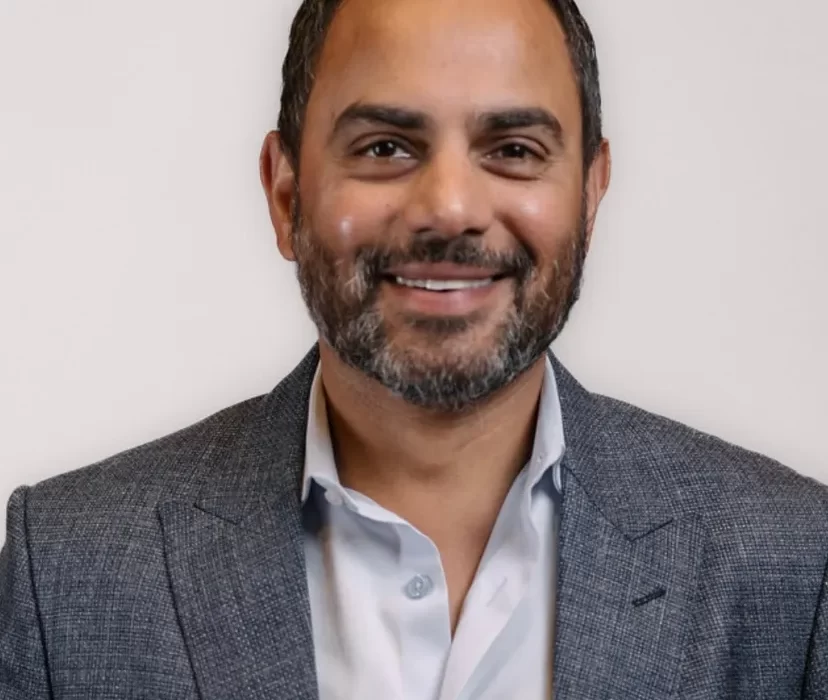
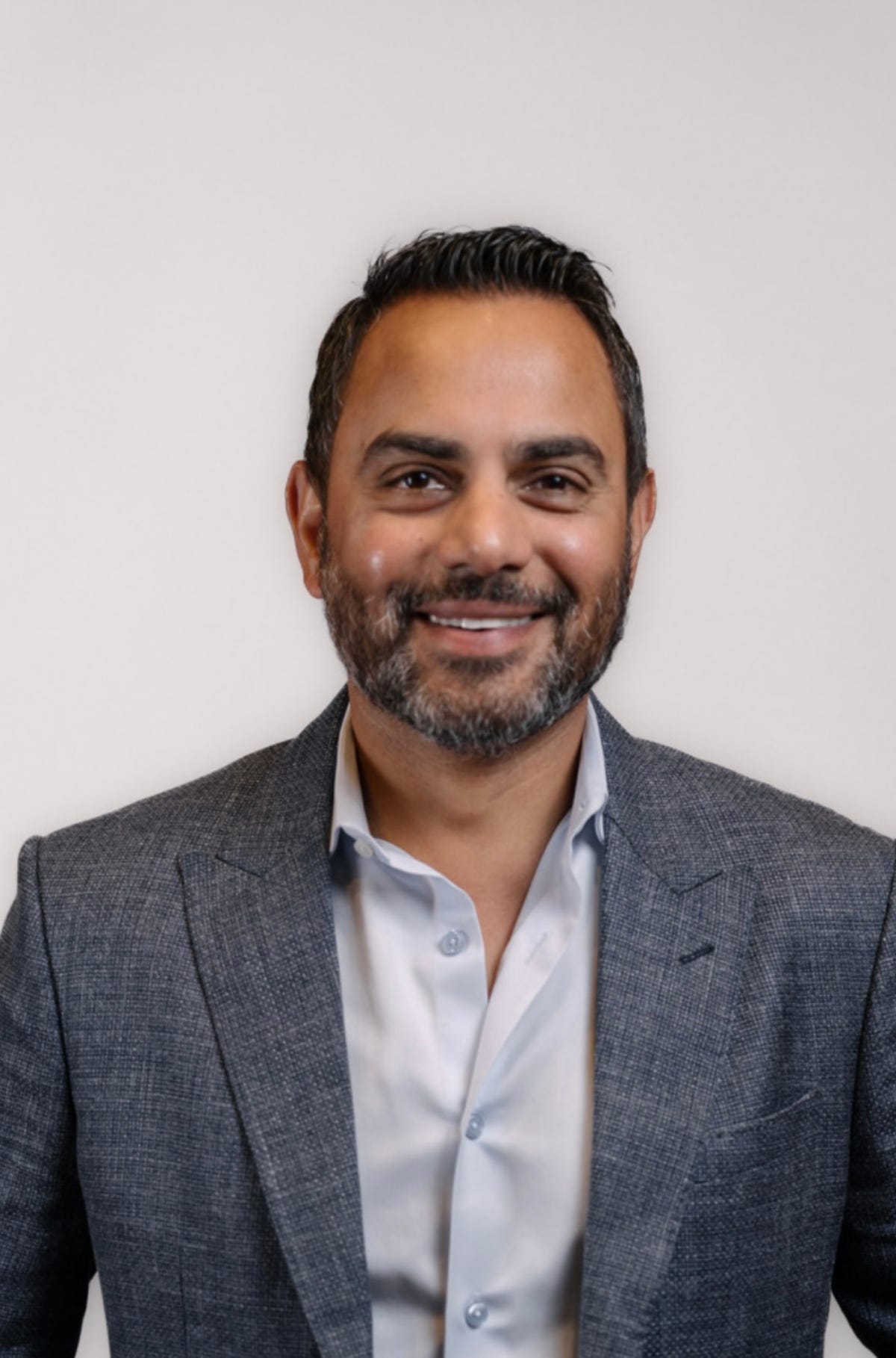
Akki Patel is the Founder and CEO of LRE & Companies and has been in the real estate industry for more than two decades.

Thank you so much for joining us in this interview series! In your opinion, were you a natural born entrepreneur or did you develop that aptitude later on? Can you explain what you mean?

I was born a serial entrepreneur. I come from a long line of business-minded individuals who paved their own ways in their industries, and I grew up witnessing the challenges and rewards of that life. I always knew that one day I would be in the same position.

Was there somebody in your life who inspired or helped you to start your journey with your business? Can you share a story with us?

I attribute who I am and the business I am in to my father. I always enjoyed real estate as a child. I knew all the mid-developers in the city I grew up in because my father was in the business. I was fascinated by designs and buildings and the fact that from a simple canvas, the ground, you can build a building, then design comes in and the community aspect. At 15 or 16 years old I would go to open houses. The creative aspect and the actual building are inspiring to me. When I came back to the United States from India, I was staying with my uncle, who received publications for hotels. I would go through them and I would call all the brokers for the listings. I was 16 years old.

What do you think makes your company stand out? Can you share a story?

Our focus sits at the intersection of real estate, hospitality and retail, and our success is built on a foundation of strong relationships and partnerships. Our relationships with cities and retail brands are unique to us; we are creative, out-of-the box thinkers and those things set us apart. Anyone can put a rectangle on the dirt. But our project in Roseville Junction, for example, exemplifies how we can bring about unique uses of space with a mix of retail and hotels. We know where the great spaces are and we can build something that contributes to the community, economically and socially.

You are a successful business leader. Which three character traits do you think were most instrumental to your success? Can you please share a story or example for each?

  1. Work ethic. You have to work a lot harder than anyone else in the office to survive in this competitive market.
  2. Knowing my niche. You’ve got to know your audience and clients and figure out the connection between what you do and what they need.
  3. I am a perpetual student. I understand that even after 25 years I still have a lot to learn.

Often leaders are asked to share the best advice they received. But let’s reverse the question. Can you share a story about advice you’ve received that you now wish you never followed?

I was warned not to pursue the company and that it would fail, and not to buy in a certain market because it would be a bad investment. In both cases, I moved ahead. My company now continues to see growth, and the markets I was told to stay away from turned out to be great investments.

Which tips would you recommend to your colleagues in your industry to help them create a work culture in which employees thrive and do not “burn out” or get overwhelmed?

Burnout is always a risk in this in the real estate industry. You have to go in with the understanding and mental preparation to face a fast-paced industry, but you will go through cycles. The most effective tool against burnout is to have fun and be passionate about what you do. For me, it’s a joy to see a project transform from a patch of land to a thriving gathering place for communities, going to restaurants, hotels, and just enjoying a place that was once nothing but dirt. Find what gives you pleasure in what you’re doing; otherwise it will always feel like a grind.

What are the most common mistakes you have seen CEOs & founders make when they start a business? What can be done to avoid those errors?

Some people start ambitious from Day 1 without having the right people and thinking they know everything. One of the most common and worst mistakes you can make is not having the right team in place and not recognizing that you don’t know everything. Our success is based on the fact that we have a great team and that everyone brings their own level of expertise and perspective.

Ok fantastic. Thank you for those excellent insights. Let’s now shift to the main focus of our interview about How to Successfully Ride The Emotional Highs & Lows Of Being An Entrepreneur.

The journey of an entrepreneur is never easy — in fact, it is filled with many challenges, failures, and setbacks. But there are also many joys, thrills and celebrations. The key is to find balance and awareness. The highs should be celebrated and leveraged to boost morale, market your success, and grow your company, but the next day it is back to work. The lows should be leveraged as teaching moments. Sure, mistakes and struggles do not define you, but they can help shape you in a positive way if you use them as lessons. Lastly, know that the highs nor the lows are temporary, so you must keep your eye on your goals and remain steady.

This might be intuitive, but I think it will be very useful to specifically articulate it. Can you describe to our readers why no matter how successful you are as an entrepreneur, you will always have fairly dramatic highs and lows? Particularly, can you help explain why this is different from someone with a “regular job”?

With a steady job comes a steady income and the ability to reapply yourself the next day. As an entrepreneur, you are taking a risk every single day, with people and families depending on your success. If you make a mistake, it can significantly impact a lot more people than it would in a regular job. Because of this, the stress level as an entrepreneur is significantly higher. You might have taken 25 years to build something that can be lost in a second.

Do you feel comfortable sharing a story from your own experience about how you felt unusually high and excited as a result of your business? We would love to hear it.

Every day I wake up I am excited and thrilled — and that is not an exaggeration. Building and touching real estate. Fills me with an extreme high because every day we have an opportunity to create something out of nothing. I see this as trying to solve puzzle and putting the pieces together — that’s the most exciting part. When I see patch of dirt become a thriving space for communities to gather, I feel an enormous sense of reward.

Do you feel comfortable sharing a story from your own experience about how you felt unusually low, and vulnerable as a result of your business? We would love to hear it.

The saying goes that it’s always lonely at the top, and there is truth to that statement. Even though you’re surrounded by friends and colleagues, when things aren’t working out, you carry that weight on shoulders alone, as the leader.

Based on your experience can you tell us what you did to bounce back?

First, I am fortunate to come from a wonderful family, so I have a strong support system. Second, I began working at the age of 15, so I learned very early on that I had to be more resilient than the average person — there is no one out there who will cry for you when your dreams of starting a business go bust. So I learned that when I got knocked down, I had to get up and keep working. You have to play the cards you’re dealt with or change how you’re playing them.

What are your “Five Things You Need To Successfully Ride The Emotional Highs & Lows Of Being An Entrepreneur”?

  1. Stay focused and stay present .
  2. Think about future not past; the present is what helps you.
  3. Find the right mentor or partner. In my case, this has been my wife, who is part of the company and is more pragmatic than I am.
  4. Build yourself a strong team and enjoy the people you’re surrounded with.
  5. Identify the positives and the opportunities in everything.

We are living during challenging times and resilience is critical during times like these. How would you define resilience? What do you believe are the characteristics or traits of resilient people?

Resilience isn’t just about continuing the work when things go badly; it’s about having the determination to succeed, especially when things go badly. It’s having faith in yourself even when others may not. This takes courage, passion, and grit.

Did you have any experiences growing up that have contributed to building your resiliency? Would you mind sharing a story?

When you start career at very young age on your own you just don’t know anything else:

I started very early in life, having started my business at just 19 years old. So I faced a lot of skepticism, a lot people who doubted that I knew what I was doing. For a young man, that can be extremely discouraging, but I dig deep and used their skepticism as an incentive to keep going. There is no greater motivator than wanting to prove people wrong. You have to bet on yourself!

In your opinion, do you tend to keep a positive attitude during difficult situations? What helps you to do so?

Yes, keeping a positive attitude is my North Star. Bad times are momentary, unless you allow it to end your pursuit.

Can you help articulate why a leader’s positive attitude can have a positive impact both on their clients and their team? Please share a story or example if you can.

As the leader, you set the tone. If you’re constantly discouraged, upset and have a defeatist attitude then your team and their work will reflect that. When a member of my team is faced with something challenging, I always change the perspective to one of opportunity. We can always find a way to make something work, even if it’s hard. When you approach everything with a positive attitude, your team will start believing that anything is possible.

Ok. Super. We are nearly done. What is your favorite inspirational quote that motivates you to pursue greatness? Can you share a story about how it was relevant to you in your own life?

If you can’t change the cards you’re dealt, change how you play your hand.”

How can our readers further follow you online?

Akkipatel.net

Lrecompanies.com

This was very inspiring. Thank you so much for the time you spent with this. We wish you continued success and good health!

CategoriesCommunity

Yuba County’s resiliency is something we all should pay attention to

Don’t overlook Yuba County.

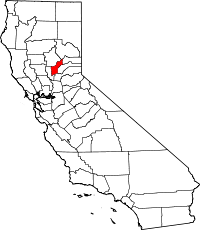
Situated about two hours each from two Northern California destination spots – San Francisco to the west and Lake Tahoe to the east – the county has plenty to offer to both residents and visitors alike, as evidenced by its steady population increase for more than a decade. That growth is expected to continue in the coming years – and the county is poised to serve as a blueprint for economic and community prosperity for the rest of the state.

The draws are obvious. Yuba County presents the perfect bucolic getaway with its unique and breathtaking natural beauty, scenic rivers, outdoor activities, and rich gold rush history. Tourists can also enjoy themselves at the Hard Rock Hotel & Casino, Marysville Drakes professional baseball games and with top concerts at the Toyota Amphitheatre.

But in regions such as Plumas Lake, residents and tourists looking for more amenities and retail and hospitality options must travel outside the area – which is why our company, in partnership with the American Hospitality group, chose this location for our much-anticipated retail development project on NEC Feather River & Chalice Creek.

As communities such as Plumas Lake grow, it’s critical that local and new businesses grow along with it, contributing to its local economy, creating more jobs, and helping the environment by eliminating the need to travel to neighboring and not-so-neighboring cities for retail, dining and lodging choices.

Adding to the community’s diverse choices of activities makes the county a prime spot for growth.

The Yuba County Economic Forecast paints a bright future. The 2022 report is predicting continued steady growth through 2027, mirroring the county’s recent history. Between 2010 and 2022, the county grew by an average of 1.3% per year – with a spike of 4.4% during the pre-pandemic year between 2019 and 2020. Its population now stands at more than 84,000, compared to 72,000 in 2010.

Yuba County proved its resiliency over the last few years. According to the county forecast, “The pandemic lockdowns and business restrictions that characterized much of 2020 and the first half of the 2021 had very little effect on Yuba County. Consequently, the Yuba labor market was one of the first counties in California to recover from the recession.”

The county forecast predicts continued prosperity, with job growth – led by the healthcare sector – averaging 1.6% through 2026. Employment in leisure and hospitality, government, and construction are also expected to be strong.

Despite a 15% increase in home prices in 2021, the median home value of $384,500 in Yuba County is much more affordable than homes in many other parts of California. For example, the typical household spends just 20% of its income on housing costs, whereas in Coastal California, households often spend 35-50% on mortgage payments or rent. It stands to reason that this will continue to attract new residents to the region, which, in turn, will contribute to the economic and population growth of the county.

It’s easy to focus on headlines from major cities across the country that have been struggling to recover from the pandemic. But what many people may be overlooking are the smaller communities, where communities are not only coming back, but are ripe with opportunities for new businesses and industries to serve growing populations and tourists.

Yuba County is one of those places that demands our attention.

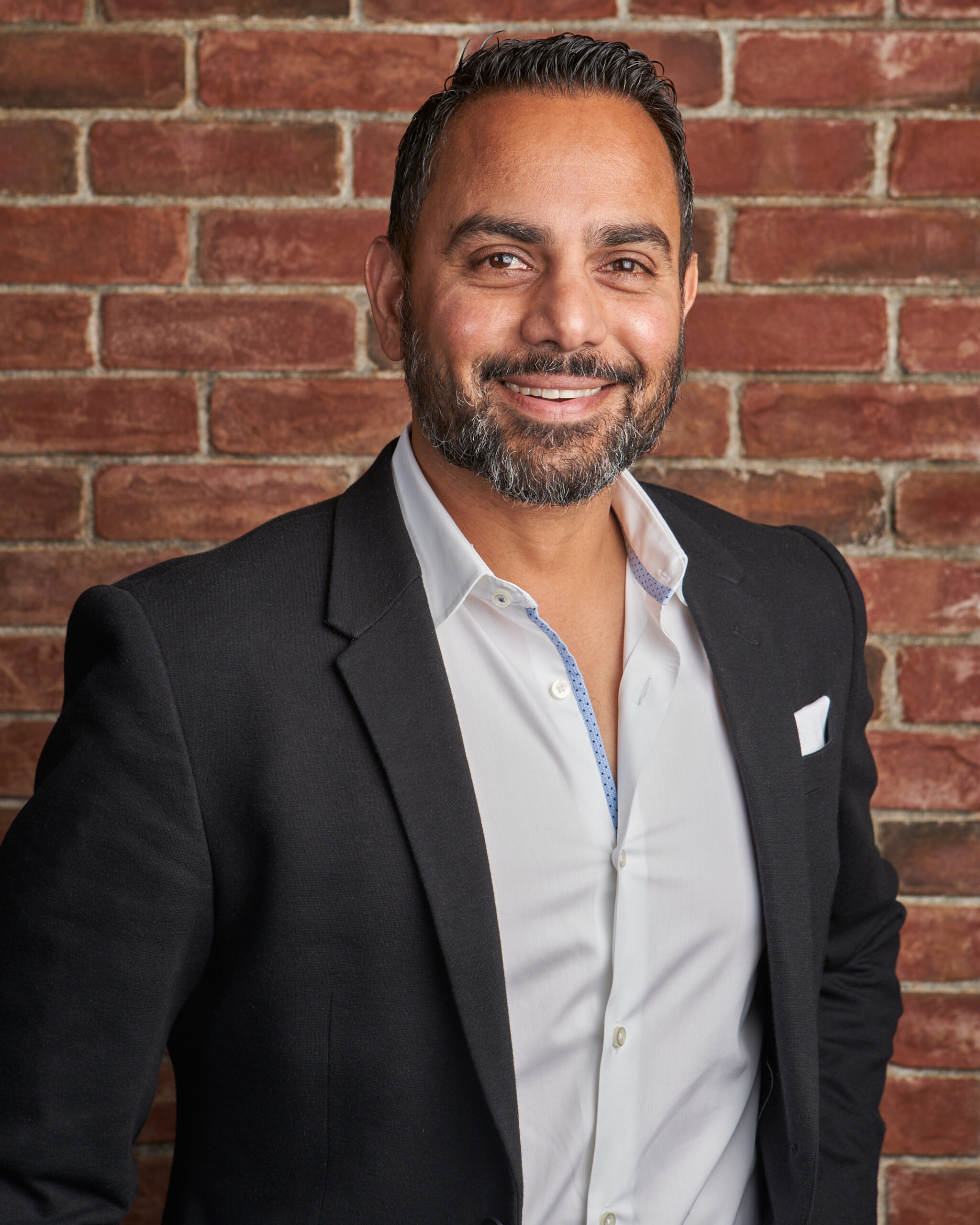
Akki Patel was inspired to launch his own career as an entrepreneur at just 20 years old, when he became the owner of his first restaurant and launched LRE & Companies in 1999. Patel holds an accounting and finance degree from the University of San Diego and is an active member of the Young Presidents Organization as well as several other business advisory boards. Patel writes about business trends and outlooks at AkkiPatel.net. He also serves on the Dignity Moves Advisory Board.

CategoriesCommunity

Akki Patel of LRE & Companies: 5 Things I Wish Someone Told Me Before I Began Leading My Company

Letting someone go is never easy. One of the most challenging parts of having your own company is knowing when to let someone go and actually doing it. This is critical to the company’s success, so you have to be mentally prepared to let someone go if that’s needed.

Asa part of our series called ‘Five Things I Wish Someone Told Me Before I Became A CEO’ we had the pleasure of interviewing Akki Patel.

Akki Patel is the Founder and CEO of LRE & Companies and has been in the real estate industry for more than two decades.

What was the “Aha Moment” that led to the idea for your current company? Can you share that story with us?

Iwas born with the idea for my company; it’s in my DNA. My great grandfather was a landowner; my grandfather was a landowner; and my father was a real estate developer. So I was always fascinated with business and the industry. I began with a company outside of the real estate industry but then launched what is now LRE & Companies, a full spectrum real estate development, asset manager, construction, and hotel management company. This was inevitable and something that I feel very passionate and at home with because it is in my DNA.

Can you tell us a story about the hard times that you faced when you first started your journey? Did you ever consider giving up? Where did you get the drive to continue even though things were so hard?

Starting a company is always going to be extremely challenging, and anyone who says differently is not being completely honest. What makes it more difficult is going in with a mindset that you know everything. Even after 25 years, I am still learning. Any challenge is an invaluable teaching moment. I was able to navigate the challenges of those early years and continue because I surrounded myself with great mentors and coaches. I have met amazing people along the journey, especially during the rockiest parts of that journey.

So, how are things going today? How did your grit and resilience lead to your eventual success?

Things today are really good, full of potential, surprise, and also challenges. One thing we have learned is to never give up; there are always going to be bad days — but when you persevere, you start noticing the good far outweighs the bad. This requires an investment and trust in yourself and being able to look beyond the moment, no matter how difficult it is.

What do you think makes your company stand out? Can you share a story?

We are an agnostic real estate developer, with a focus on real estate, hospitality and retail. Our success is built on a foundation of strong relationships and partnerships. Our relationships with cities and retail brands are unique to us; we are creative, out-of-the box thinkers and those things set us apart. Anyone can put a rectangle on the dirt. But our project in Rocklin University Square, for example, exemplifies how we can bring about unique uses of space with a mix of retail and hotel. We know where the great spaces are and we can build something that contributes to the community, economically and socially.

Can you share a story about the funniest mistake you made when you were first starting? Can you tell us what lessons or ‘takeaways’ you learned from that?

When you are young and ambitious as I was when I started my company, it’s easy to think you have the Midas Touch. It’s easy to think that once you acquire something you will automatically create value, but that’s not always the case. You learn right away that it doesn’t work that way. We used to acquire things and expected sales to just take off, but that didn’t happen. It’s about strategy, geography, demographic, and so many other things that go into creating value.

Often leaders are asked to share the best advice they received. But let’s reverse the question. Can you share a story about advice you’ve received that you now wish you never followed?

I was warned not to pursue the company and that it would fail, and not to buy in a certain market because it would be a bad investment. In both cases, I moved ahead. My company now continues to see growth, and the markets I was told to stay away from turned out to be great investments.

You are a successful business leader. Which three character traits do you think were most instrumental to your success? Can you please share a story or example for each?

  1. Work ethic. You have to work a lot harder than anyone else in the office to survive in this competitive market.
  2. Open to innovation. Embrace new ways of doing business through advances in technology, and think beyond traditional business practices.
  3. Patience. This is a long game; approach each deal and strategy accordingly.

Which tips would you recommend to your colleagues in your industry to help them to thrive and not “burn out”?

Burnout is always a risk in this in the real estate industry. You have to go in with the understanding and mental preparation to face a fast-paced industry, but you will go through cycles. The most effective tool against burnout is to have fun and be passionate about what you do. For me, it’s a joy to see a project transform from a patch of land to a thriving gathering place for communities, going to restaurants, hotels, and just enjoying a place that was once nothing but dirt. Find what gives you pleasure in what you’re doing; otherwise it will always feel like a grind.

What are the most common mistakes you have seen CEOs & founders make when they start a business? What can be done to avoid those errors?

Some people start ambitious from Day 1 without having the right people and thinking they know everything. One of the most common and worst mistakes you can make is not having the right team in place and not recognizing that you don’t know everything. Our success is based on the fact that we have a great team and that everyone brings their own level of expertise and perspective.

In your experience, which aspect of running a company tends to be most underestimated? Can you explain or give an example?

The most underestimated part of running a company is the culture you create. It is critical to have the right people working with you, and as a leader you have to foster a culture of creativity and collaboration.

What are your “5 Things I Wish Someone Told Me Before I Began Leading My Company”?

  1. This is not going to be a 9–5 job. When you start your own company, don’t expect it to fall neatly into regular business hours.
  2. You won’t make money every day. Because it’s not a regular 9–5 job, it’s also not a regular paycheck in the beginning. Be prepared for that and know it will get better if you don’t give up.
  3. Your time won’t be as flexible as you might think. When starting a company, many people think they are breaking the chains of working for someone else, and that they will have much more time to do things they like. This is not always true, especially in the beginning. And in fact, you will probably need to invest more time in work to get it going.
  4. You won’t always align with everyone, and vice versa. If you’re smart, would will surround yourself with experienced, smart, and diverse people. As a leader, it’s your job to push people sometimes and make them think differently about something, or approach something in a different way. You must also have the openness to do the same.
  5. Letting someone go is never easy. One of the most challenging parts of having your own company is knowing when to let someone go and actually doing it. This is critical to the company’s success, so you have to be mentally prepared to let someone go if that’s needed.

You are a person of great influence. If you could start a movement that would bring the most amount of good to the most amount of people, what would that be? You never know what your idea can trigger. 🙂

I think as companies grow, so should their commitments to the communities they serve. In every city we have a project in I am looking into the local nonprofits, the community needs and finding ways to contribute, not just to the community’s economy but to its social needs.

Thank you for these fantastic insights. We greatly appreciate the time you spent on this.

About the Interviewer: Douglas E. Noll, JD, MA was born nearly blind, crippled with club feet, partially deaf, and left-handed. He overcame all of these obstacles to become a successful civil trial lawyer. In 2000, he abandoned his law practice to become a peacemaker. His calling is to serve humanity, and he executes his calling at many levels. He is an award-winning author, teacher, and trainer. He is a highly experienced mediator. Doug’s work carries him from international work to helping people resolve deep interpersonal and ideological conflicts. Doug teaches his innovative de-escalation skill that calms any angry person in 90 seconds or less. With Laurel Kaufer, Doug founded Prison of Peace in 2009. The Prison of Peace project trains life and long terms incarcerated people to be powerful peacemakers and mediators. He has been deeply moved by inmates who have learned and applied deep, empathic listening skills, leadership skills, and problem-solving skills to reduce violence in their prison communities. Their dedication to learning, improving, and serving their communities motivates him to expand the principles of Prison of Peace so that every human wanting to learn the skills of peace may do so. Doug’s awards include California Lawyer Magazine Lawyer of the Year, Best Lawyers in America Lawyer of the Year, Purpose Prize Fellow, International Academy of Mediators Syd Leezak Award of Excellence, National Academy of Distinguished Neutrals Neutral of the Year. His four books have won a number of awards and commendations. Doug’s podcast, Listen With Leaders, is now accepting guests. Click on this link to learn more and apply.

CategoriesCommunity

Commercial Real Estate Today: Akki Patel Of LRE & Companies On 5 Things You Need to Create a Highly Successful Career in the Commercial Real Estate Industry Today

Every day is not going to be a good day — but there will be great days. Have patience.


The commercial real estate industry is a dynamic and challenging landscape that offers enormous potential for success. However, it requires a unique blend of skills, knowledge, and aptitude to truly excel. How does one establish themselves in such a competitive field? What does it take to consistently rise to the top in commercial real estate? How does one rise above the headwinds that are challenging the commercial real estate industry today? In this interview series, we are talking to commercial real estate professionals, brokers, investors, leaders of Real Estate Firms and Real Estate Investment Trusts (REITs), as well as anyone who’s found significant success in this industry. As part of this series, we had the pleasure of interviewing Akki Patel.

Akki Patel is the Founder and CEO of LRE & Companies and has been in the real estate industry for more than two decades.

Thank you so much for joining us in this interview series! Before we dive in, our readers would like to learn a bit about your origin story. Can you share with us a bit about your childhood and how you grew up?

Iwas born in San Francisco and raised in India. I returned to America at the age of 15, having come from a family with a proud, multi-generational history of business innovation in the real estate and construction sector.

Can you share with us the ‘backstory’ of how you got into the real estate business?

I always enjoyed real estate as a child. My father designed middle-income housing — and while it was nothing fancy, I was fascinated by the process and the result. I was fascinated by designs and buildings and the fact that from a simple canvas, the ground, you can build a building, then design comes in and the community aspect. At 15 or 16 years old I would go to open houses. The creative aspect and the actual building are inspiring to me. When I came back to the United States from India, I was staying with my uncle, who received publications for hotels. I would go through them, and I would call all the brokers for the listings. I was 16 years old.

Can you tell us about your company and what makes it stand out?

We are an agnostic real estate developer, with a focus on real estate, hospitality and retail. Our success is built on a foundation of strong relationships and partnerships. Our relationships with cities and retail brands are unique to us; we are creative, out-of-the box thinkers and those things set us apart. Anyone can put a rectangle on the dirt. But our project in Roseville Junction, for example, exemplifies how we can bring about unique uses of space with a mix of retail and hotels. We know where the great spaces are and we can build something that contributes to the community, economically and socially.

Can you tell our readers about the most exciting new projects you are working on now?

Every project is exciting because we are literally creating something out of nothing — with each project unique to the community it’s in. Just to name a couple: We currently have our Roseville Junction project in Roseville, California, in partnership with the American Hospitality Group, which will function as a sports and entertainment complex in Placer County. The Electric Pickle, Roseville Junction’s entertainment and sports complex, will comprise a bocce ball court and 10 pickleball courts, along with dining venues. Roseville Junction will feature “Social Connection” — a one-of-a-kind gathering place with curated food and beverage offerings. Already signed on as an anchor tenant will be Fieldwork Brewing Company, a popular brewery in Northern California.

Another exciting project that we’re working on is Fernley Promenade, a 13-acre mixed-use development along Interstate 80 in Fernley, California. The project will be the first shopping center development in Fernley in over a decade. The first confirmed tenant for Fernley Promenade is a 98-room Home2 Suites by Hilton with a swimming pool and fitness center. The development will also feature three junior retail anchors, as well as various dining and shopping options. Retail space, ranging from 1,200 square feet to 20,000 square feet, is currently available for lease. The property can accommodate freestanding buildings with drive-thru, junior anchor and shop space.

Ok, let’s now move to the main part of our interview about commercial real estate. What are the 3 things that most excite you about the industry now? Why?

  1. Many people might not realize that commercial real estate requires a lot more creativity than traditional residential real estate. You have to have the right project in the right place, and the right partners to see the project through.
  2. The markets are more challenging in commercial real estate so that requires out-of-box thinking and coming up with strategic approaches, which is also where the creativity comes in.
  3. If the “Doom Loop” in commercial real estate is real, there are a lot of buying opportunities in coming months — and that is definitely something to look out for.

What are the 3 things that concern you about it? Why? What should be done to address and alleviate those concerns?

  1. My biggest concern in the industry right now are the increased interest rates. If they stay where they are we have to figure out how to make deals work. We will see these rates go down over time but in the next 24 months developers may have resource debts and no bank wants that. Lenders should be willing to work with buyers so they can ride out this wave rather than foreclosing on larger projects.
  2. There are certain asset classes, such as office spaces, where we might see challenges in the next 12–24 months. This is contributing to the “doom-loop” narrative and impacts confidence in the market. As I mentioned before, these also pose buying opportunities. In some markets, it’s important we open up housing shortages by making housing approvals more accessible so people can build faster and move in, particularly in coastal markets.
  3. Construction costs haven’t dropped as much as we expected. They have stabilized, but they remain higher than in 2019, so also makes it harder for new construction development projects.

If you had the power to put in place 3 changes to improve or reform the industry, what would you suggest? Please share stories or examples, if possible.

This speaks to my previous responses. The biggest thing is that interest rates are historically high and until that comes down you will not see a lot of deals pencil out right now.

How has technology changed the commercial real estate industry, and how do you foresee it shaping the future of the sector?”

  1. Technology has definitely changed the industry. For example, with Ai you can gather a lot more data than what we typically relied on commercial brokers to provide.
  2. Technology has also enabled us to make buildings a lot more efficient with energy solutions. EV chargers, for example, are not just luxury anymore, they are requirements for our hotels and retail. They are now a necessity.
  3. For retail, there is a lot more data through geofencing that shows consumer behaviors, who is shopping, and here. We didn’t have that before and it helps inform our projects.

I am hearing the phrase “Stay alive until 2025” a lot. What is your plan to survive in the current market?

To stay alive until 2025!

For a young person who would like to eventually make a career in commercial real estate, which skills and subjects do they need to learn?

  1. Work ethic. You have to work a lot harder than anyone else in the office to survive in this competitive market.
  2. Technology. Embrace new ways of doing business through advances in technology, and think beyond traditional business practices.
  3. Patience. This is a long game; approach each deal and strategy accordingly.

Do you have three things you would advise a new real estate professional to avoid?

  1. Do not work behind your desk: Be out in the market looking for opportunities.
  2. Do not think you know everything. You are constantly learning, so open your mind when looking at deals and be creative
  3. Don’t expect to get rich quick. There is no fast buck here. Put in the work.

When evaluating deals or opportunities in real estate, what are the most important factors you look for and why? Can you provide some examples?

We underwrite deals more carefully than ever before. Capital markets today, where we are seeing high interest rates, do not make it easy for many deals to pencil out.

We weigh the value and ask ourselves: Is it cheaper to build or cheaper to acquire?

Can you share a story with us about the hardest deal you made, that ended successfully for you?

There was a deal that took us 2 years to get the co-tenancy clause approved after we bought the land. We would have faced a lot more risk in that deal if the co-tenancy clause wasn’t approved, but we were able to successfully negotiate that and break ground.

Based on your personal experience and success, can you please share “Five Things You Need To Create A Highly Successful Career In The Commercial Real Estate Industry”?

1 . Know your cities and your local municipalities and invest in understanding what makes each community unique.

2 . Real estate is not just about sending out a flier; it’s about working with your clients’ needs. Take the time to understand what they are looking for and how to address their unique needs.

3. If you’re expecting a steady income this is not the industry for you. There is always a balance of risk and reward.

4. Every day is not going to be a good day — but there will be great days. Have patience.

What advice would you give to another real estate professional about improving the work culture, building team morale, and helping each employee thrive?

It’s always about teamwork and every project requires a team effort. There are a lot of people from your back office to your people out in the field who will touch the project and it’s a team effort that makes any project successful.

You are a person of great influence. If you could start a movement that would bring the most amount of good to the most amount of people, what would that be? You never know what your idea can trigger. 🙂

I sit on the board of DignityMoves, an amazing organization that works to end unsheltered homelessness in communities by building Interim Supportive Housing as a rapid, cost-effective, and thus, scalable solution. I am passionate about addressing the issue of the unhoused and solving homelessness by utilizing resources that a city already has. For example, land that may be sitting empty and dormant for 10 years can be used for housing the unhoused.

How can our readers further follow your work online?

Akkipatel.net

Lrecompanies.com

This was very inspiring. Thank you so much for joining us!

CategoriesCommunity

Dignity Moves Opens 32 “Tiny Homes” in Santa Barbara

ands Across Montecito co-founder Kathryn Washburn got a call from Dignity Moves a couple of weeks ago, asking if she’d support the new tiny homes in downtown Santa Barbara. As a strong member on the Hands Across Montecito team that has achieved great results in helping people leave homelessness, Kath wasn’t sure about this. She wanted to see it.

So she asked for a tour, and after seeing it, immediately went to work to provide supplies for one of the units to make it a home.

Then she called the Hands team, and Andrea Eltinge and I went with her to the ribbon-cutting last weekend. It was impressive.

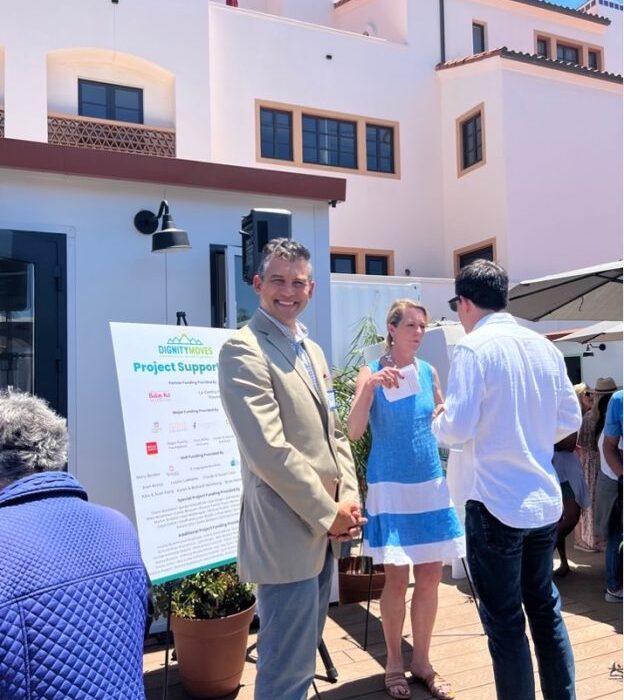
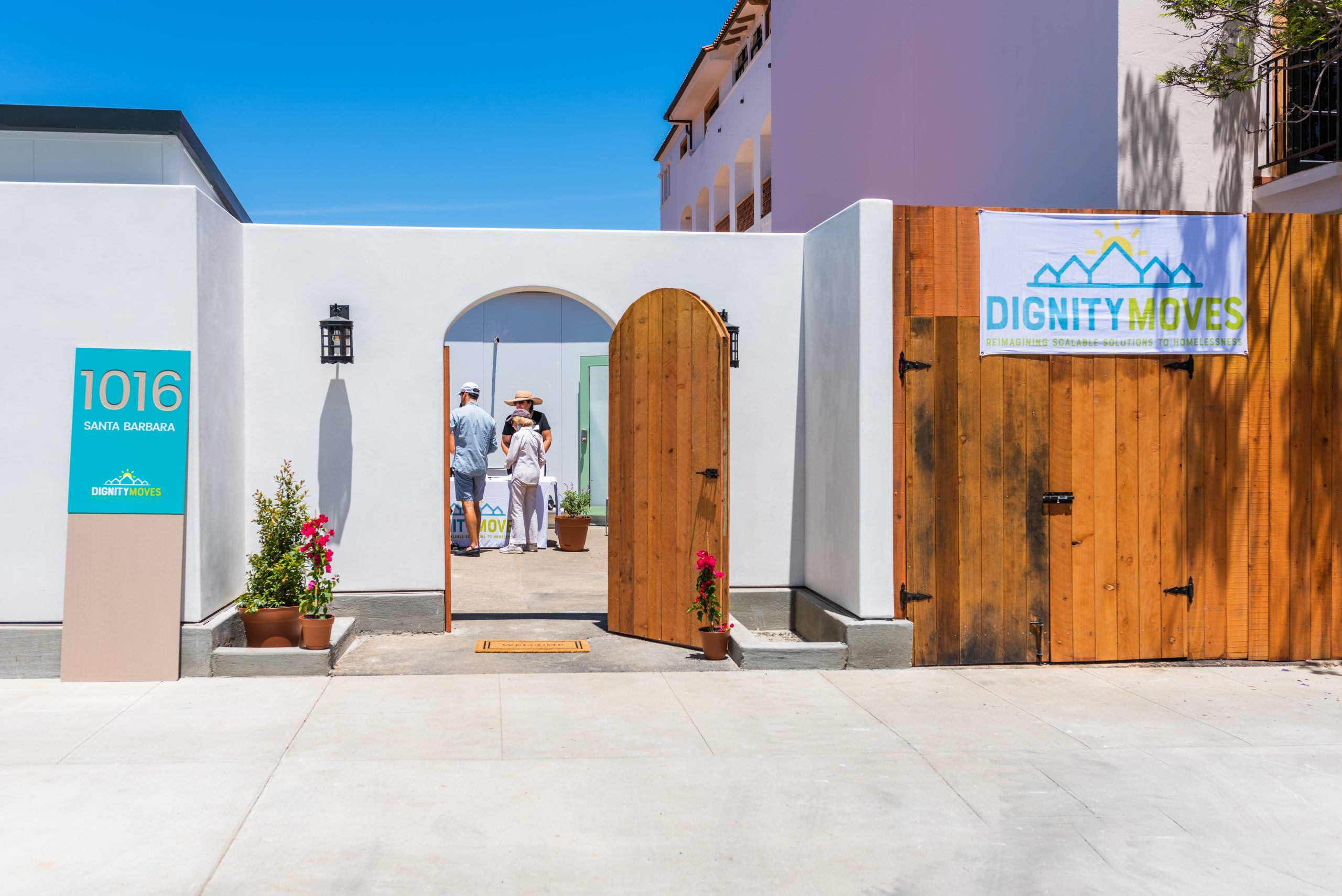
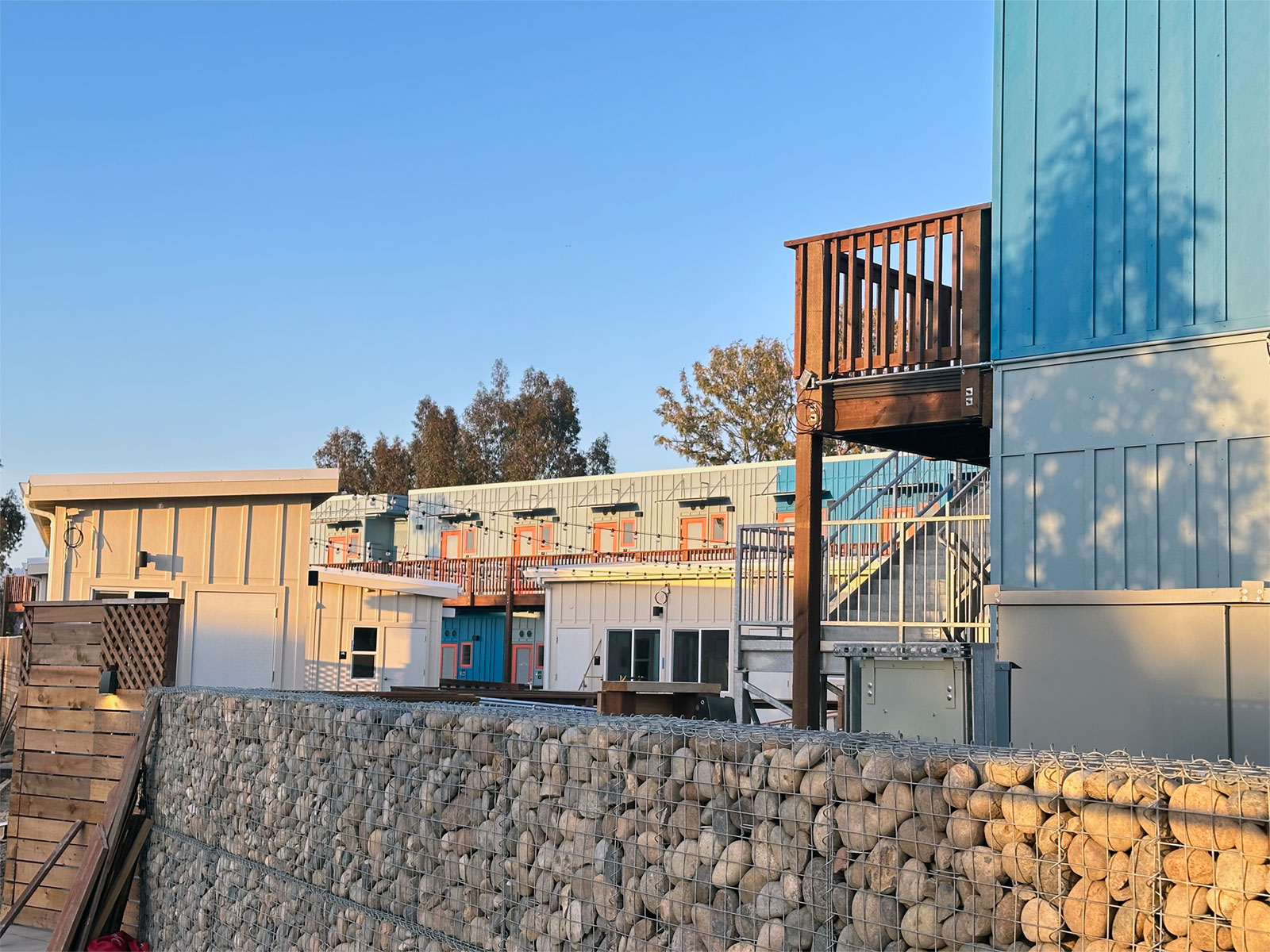
A small, narrow parking lot owned by the county in the 1000 block of Santa Barbara Street had been turned into a village of 32 tiny homes, with a central kitchen area, bathrooms, decking, and thoughtfully placed potted plants. Here’s some of the story on how that happened:

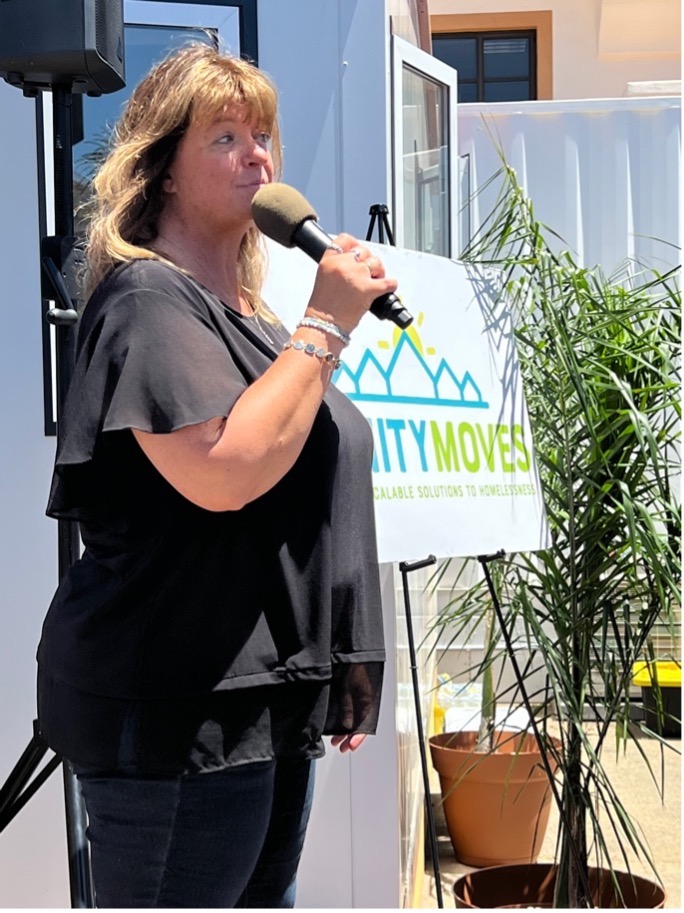
Elizabeth Funk, the founder and CEO of Dignity Moves, said they ordered the units October 1. Now, they’re about to move 60 people into these 32 units. Matt Riley, a Montecito resident on the Dignity Moves board, was credited for tireless ‘Do-ism’ in making this happen so quickly.

Funk said there were many similar stories: Many people made newly homeless are not addicted to substances, but 30 days after being on street, your chances of developing a lifetime addiction skyrocket. Then climbing out of homelessness becomes even more difficult.

Something we’ve experienced on the Hands Across Montecito project: no one wants to go into a shelter. It’s not hard to see why. It’s bunk beds. It’s crowded, in a pandemic. You have to be in early at night. Your stuff often gets stolen while you sleep. You have to be out at 5 or 6 am in the morning, with nowhere to go. It’s ‘near jail’ conditions, and dehumanizing.

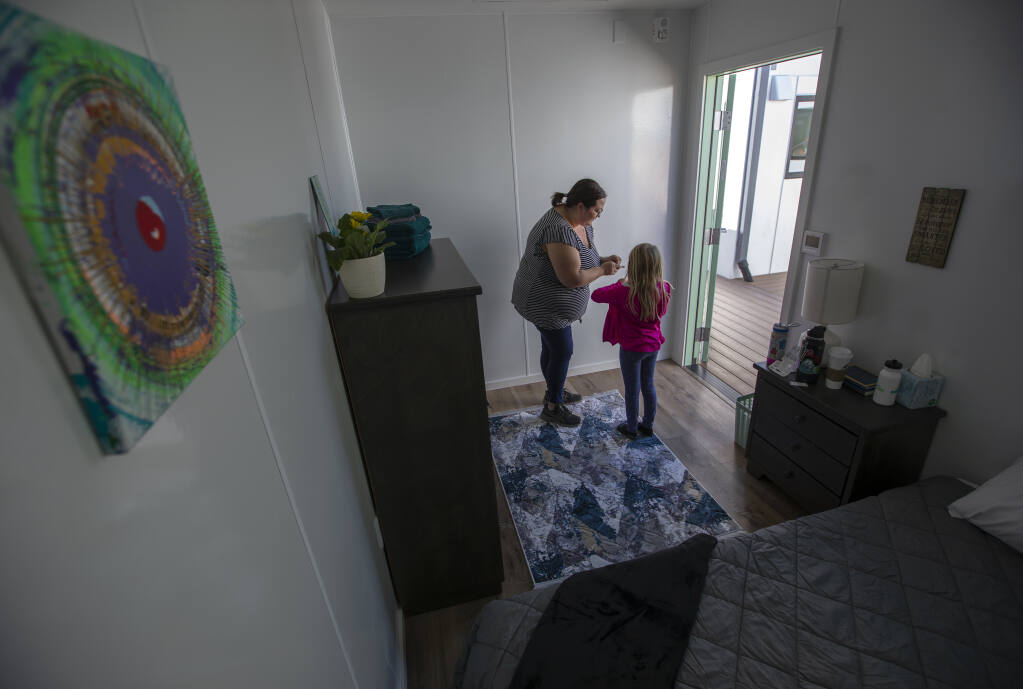
Dignity Moves offers what we’ve long needed: bridge housing – a temporary indoor bridge from homelessness to permanent housing. These units are meant to provide security, via four walls, 64 square feet of space, a roof, and a locking door. Hands Across Montecito leverages hotel rooms as bridge housing. It’s far easier for CityNet case managers to help people move forward when they’re in a stable situation versus trying to find them in camps, where they’re often forced to move around.

Kathryn Washburn of Hands Across Montecito in front of the unit she provisioned

Supervisor Williams said, “This is an example of what community can do. We should not stop here. Some say certain people will never come inside. That may be true, but we’ve never yet run out of the people who do want to come in off the street.”

Supervisor Hart noted the “enthusiasm that this is a different tipping point in dealing with the problem of homelessness. When you see these tiny homes, you realize this is what we need to do. It is shelter with dignity, that restores people’s humanity.”

The site will have onsite management, and services that help people transition out of homelessness provided by Good Samaritan, a huge nonprofit from Santa Maria. I’ve had a lot of experience with them as a member of the Behavioral Wellness Commission. Sylvia Barnard does a fine job overseeing projects like this that move people out of homelessness. The construction costs of $1.4 million were covered by a combination of county funding and philanthropy.

Councilmember Jordan thanked partners ACT and CityNet, who have also been our partners in Hands Across Montecito.

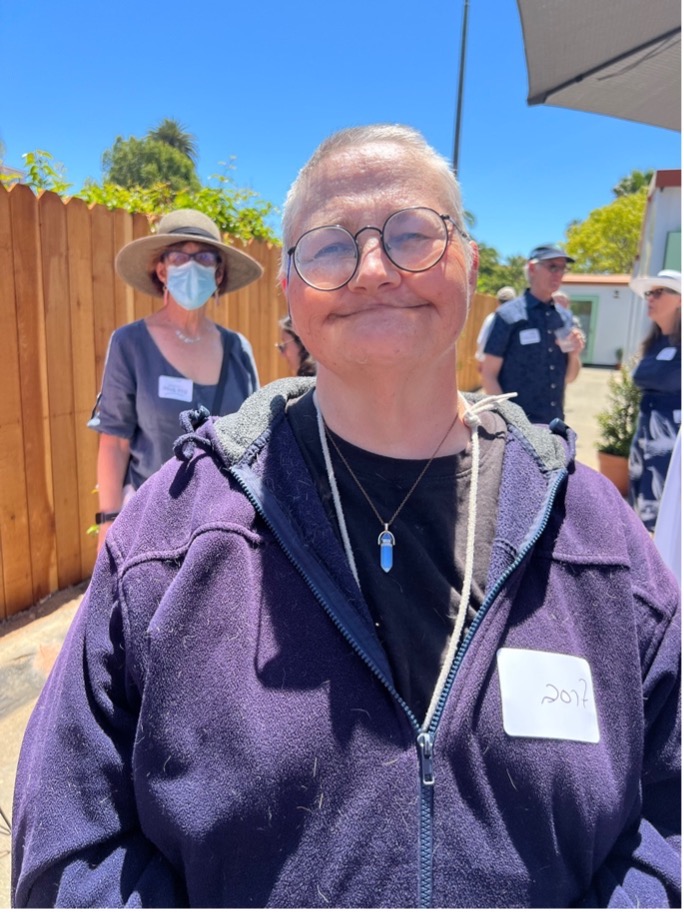
On my way out, I ran into Frog, who I’d met before at group feedings for the homeless in Santa Barbara. She’s been without a home since 2004. She will be moving to unit 13, as it’s lucky for her.

There’s a commitment to do a similar project in North County, but at least one more tiny home village is needed in the South County. The ideal site is a parking lot that’s not being used, or is under-used, and somewhat centrally located. If you know of one, let us know! Email info@montecitoassociation.org.

Sharon Byrne is the Executive Director of the Montecito Association

CategoriesCommunity

DignityMoves Takes on Homelessness with an Innovative Approach

There are no easy solutions to the homelessness issue that affects many of our communities across the country. In California alone, the population is estimated at 172,000, or 30 percent of all homeless people in the United States, according to 2022 data from the U.S. Department of Housing Development. Some experts believe those numbers are underestimated, and the population could balloon even more as federal emergency rental assistance and other programs during the pandemic have come to an end. As such, the homelessness crisis needs to be treated as an emergency. We need bold and creative thinkers to get a foothold on this growing problem, which stems largely from California’s exorbitant housing prices. That’s where Dignity Moves comes in. The charity organization’s innovative approach provides interim supportive housing in such California communities as San Francisco, Alameda, Rohnert Park, Santa Barbara and Santa Maria.

  1. A Place for Stabilization, Rebuilding Lives The interim housing gives those in need a stop-over between the streets and permanent housing or, as described in the Dignity Moves website, a “place where people can get out of survival mode, take a breath, and have the mental and emotional capacity to focus on stabilizing and rebuilding their lives.” I am proud to say that I recently became a member of Dignity Moves’ Advisory Task Force, and am looking forward to working within the organization to advance its innovations. In 2023,DignityMoves has plans to expand beyond California and reach out to communities around the country similarly overwhelmed by homelessness. We spend billions on the issue at the federal, state and local levels, but the majority of those dollars are diverted toward permanent supportive housing. They are, of course, necessary, butthey are just one part of the solution. Dignity Moves has found that up to nine of 10 unhoused people will refuse placement in“ congregate” shelters. They might fear for their safety or that their belongings will be stolen, or perhaps the shelters do not allow couples or pets. But the organization says no one has yet turned down one of its temporary private rooms, and the first step in helping unhoused people rebuild their lives is simply to get them off the streets. Model for Success
Dignity Moves builds communities on borrowed land. It identifies an underutilized or vacant parcel of land–perhaps even a parking lot–and negotiates with the owner to create a temporary community for up to three years. Their generous landlords have included private landowners, governments, churches and hospitals. A half-acre plot can accommodate a community with 70 rooms, plus common areas. Once the lease agreement is up, Dignity Moves picks up its prefabricated modular units and relocates them to a new community nearby.

Dignity Moves has found that those living in interim housing–with the stresses of living on the streets gone–become more self-sufficient, less dependent on government assistance and find their own way out of homelessness. To learn more, visit dignitymoves.org.

CategoriesCommunity

Dignity Village Grand Opening Celebration Set for May 3

The City of Alameda is hosting a grand opening celebration at Dignity Village on Wednesday, May 3 at 10 a.m. – and the public is invited. Dignity Village, a two-story, 47-unit Interim Supportive Housing project at 2350 Fifth St., will provide shelter for individuals experiencing homelessness or chronic homelessness. The grand opening celebration will be at the site; please RSVP online.

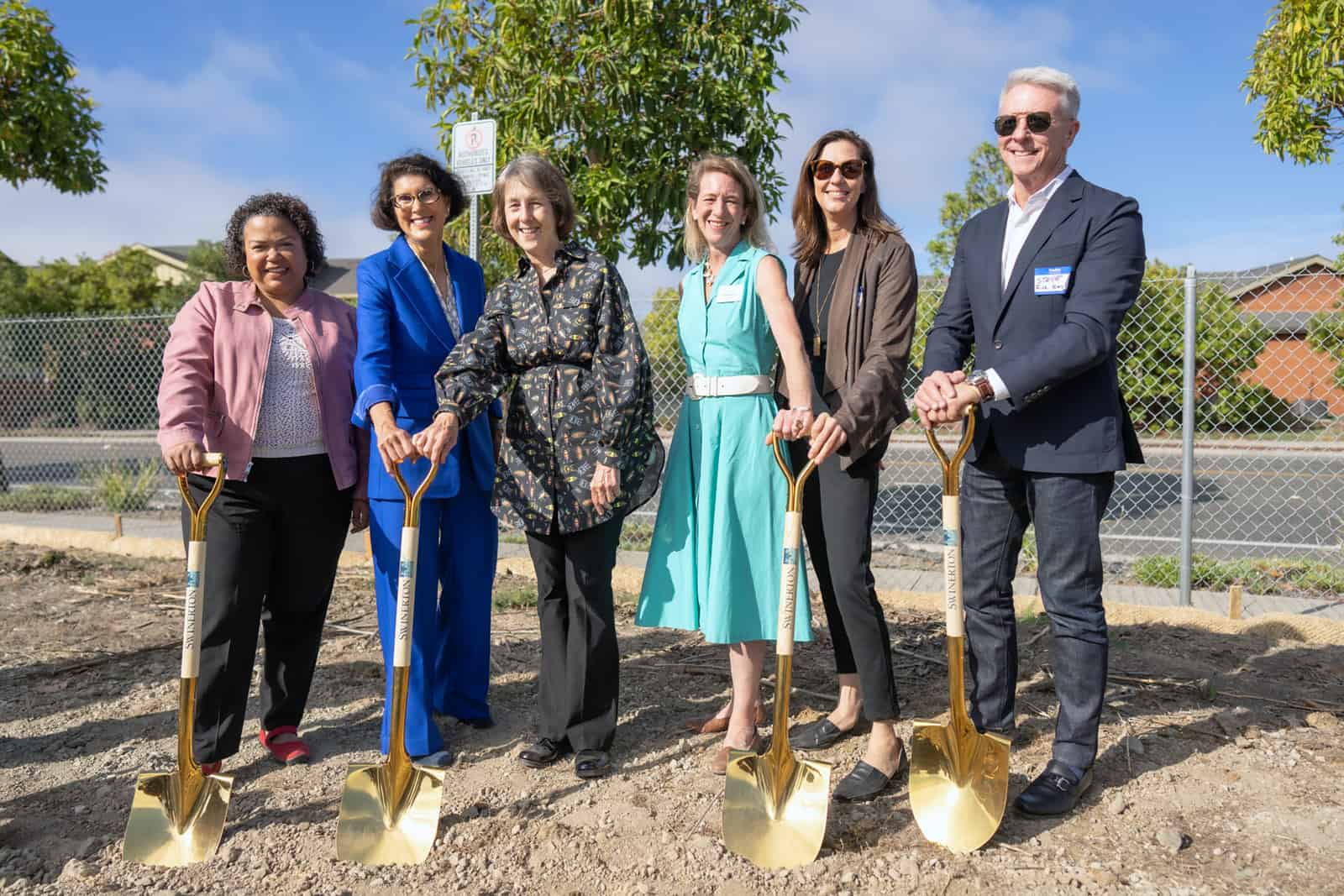
Alameda Post - Dignity Village groundbreaking ceremony, Oct 25, 2022.
Dignity Village groundbreaking ceremony, Oct 25, 2022. Photo Maurice Ramirez.

Dignity Village will be capable of serving up to 61 individuals, with five units specifically set aside for homeless youth aged between 18 to 24. Each unit measures 138 square feet and is equipped with a private, ensuite bathroom. Dignity Village will also contain additional community buildings, including a dining space, meeting rooms, private offices for support services staff, and storage for resident belongings.

People in need of housing will be referred by the Homeless Management Information System, managed by Alameda County Health Care Services Agency’s Office of Homeless Care and Coordination Coordinated Entry Program. During the initial housing placement, Alameda’s unhoused residents will be given priority.

Donut Fun Run October 21, 2023
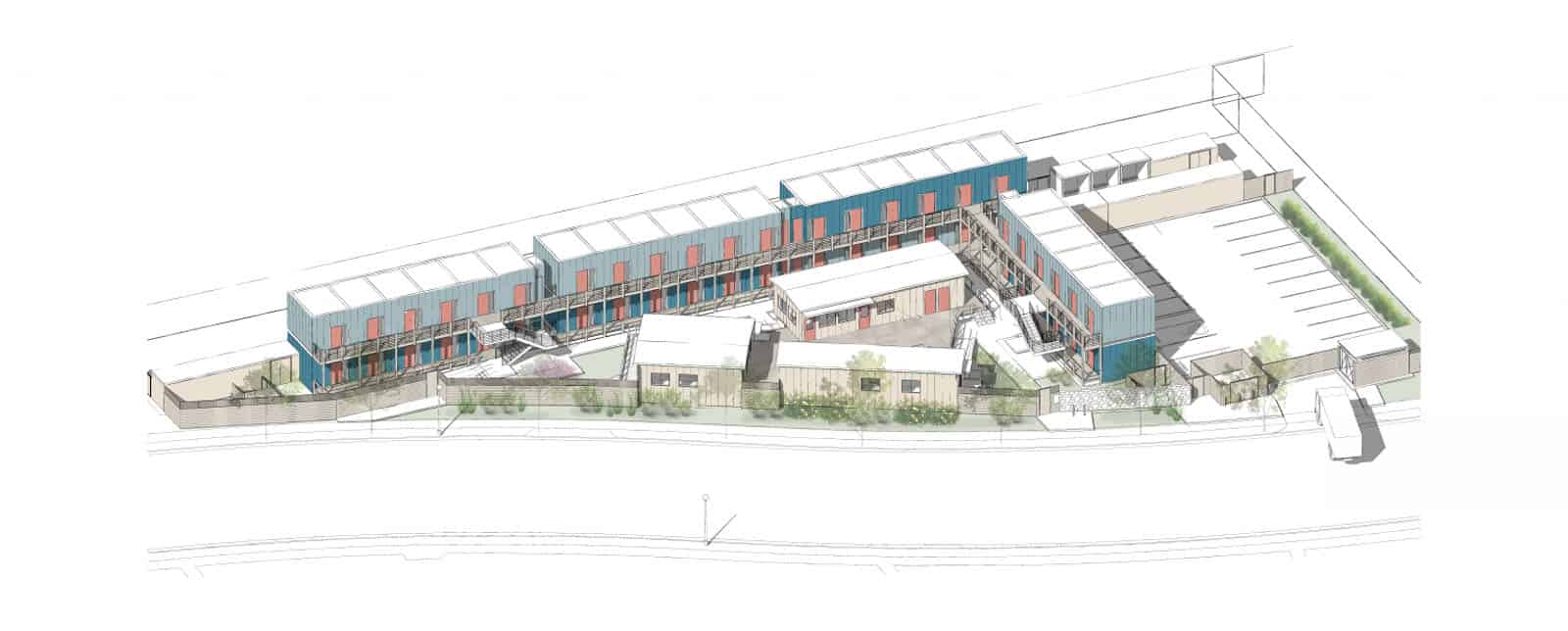
Alameda Post - a birds eye view of Dignity VIllage. There is a long two story wall of small apartments and a few shorter buildings in the middle. It is up next to a road, and there's a small parking lot. The whole development is i the shape of a very tall, thin right triangle.
Bird’s-eye view of the plan for Dignity Village. Image Dignity Moves.

The City led the effort to develop Dignity Village, partnering with nonprofit developer DignityMoves and onsite service provider and property manager Five Keys Schools and Programs. The City was awarded a $12.3 million grant from the State’s Homekey Program to build Dignity Village, and $2.35 million from Alameda County to cover five years of operating services.

Alameda Post - Dignity Village logoCommunity members may contribute to the Dignity Village Fund-A-Need in three different ways:

  • Donate to the GoFundMe campaign to support the purchase of durable furnishings and basic necessities for each unit.
  • Purchase new resident welcome basket items from the Amazon Wishlist.
  • Volunteer time to help prepare rooms for occupancy.

The City of Alameda has been working to provide interim supportive housing for those experiencing homelessness or chronic homelessness. The creation of Dignity Village is a significant step towards supporting those most in need.

Alameda Post - Julia Park Tracey The Bereaved

DignityMoves serves as the project development manager, managing the architect, general contractor, and other project consultants to successfully complete the project, while adhering to the strict guidelines of the California Housing and Community Development Homekey 2 grant.

Alameda Post - nearly complete construction at Dignity Village
A view from Fifth Street into Dignity Village as construction nears completion on April 12, 2023. Photo Adam Gillitt.

Five Keys will serve as the onsite service provider and property manager for at least the first five years of operation. Their services will include intensive case management, robust housing navigation and readiness services, good neighbor practices and resident education, community event planning, and property management inclusive of routine maintenance of the units, 24/7 security, and janitorial services. Five Keys will operate the project using “Housing First” principles and will coordinate with the City and existing social service providers to meet and maintain California occupancy requirements.

CategoriesCommunity

Rohnert Park’s first homeless housing site opens Monday

Rohnert Park will welcome the first residents to its new $15 million homeless housing site on Monday.

The 60-unit project on Labath Avenue is Rohnert Park’s first effort to house some of its estimated 250 unsheltered residents.

Officials in Sonoma County’s third largest city hope the new space provides them with an additional tool to address rising homelessness, particularly a large encampment on Roberts Lake Road that has caused growing concern among residents and businesses.

“Labath Landing gives us a really important asset to respond to homelessness in Rohnert Park,” Assistant City Manager Don Schwartz said.

The project provides people experiencing homelessness with temporary housing and wraparound services while they work with a case manager to find lasting homes. The city anticipates serving about 100 people a year there, Schwartz said.

The facility, less than a mile south of Graton Resort and Casino, was paid for through the state’s Project Homekey. The $3.6 billion program launched in 2020 gives local jurisdictions and tribal governments money to repurpose motels for housing and build new shelters.

On Wednesday, about 50 construction workers raced to finish work at the city-owned acre lot, paving the parking lot and access road, nailing down decks and installing landscaping.

Volunteers were expected to be on site to set up furniture and decorate the rooms in the coming days.

Rohnert Park officials on Sunday will celebrate the completion of the project with tours of the facility and a ceremony before transporting new residents to the site on Monday.

The city anticipates units will be 90% occupied when it opens, Rohnert Park’s Housing Administrator Jenna Garcia said.

Officials have made offers to about 50 people camping in the commuter parking lot on Roberts Lake Road and in an encampment in Hinebaugh Creek to move into Labath Landing, Garcia said.

“People are really eager to move in,” she said.

Officials will reorganize remaining residents at the commuter lot into a smaller, managed camp on the east side of the lot after transitioning people into the new units.

Labath Landing is made up of about a dozen prefabricated modular homes.

People will be housed in small private rooms, each outfitted with a lofted twin bed with storage space below and a desk. Twelve of the rooms are compliant with the Americans With Disabilities Act and are slightly larger with capacity for up to two people such as a couple.

Residents will share communal bathrooms and there is a community room with a dining area, conference room and computer lab. The campus has laundry facilities, additional storage space, a community garden and pet relief area.

Labath Landing will be operated by Milpitas-based nonprofit HomeFirst, which will have staff on site to provide case management, mental health counseling and other services. Prepared meals will be given to residents.

The majority of the units are reserved for individuals with high needs such as those considered chronically homeless, older residents and people with disabilities or health issues, Garcia said.

Chronic homelessness, where a person has been continually homeless for a year or more or has experienced homelessness on several occasions within the past three years, spiked in Sonoma County over the past two years despite a surge in government spending, according to a February point-in-time count.

In approving the project last year, city officials said Rohnert Park needed more housing for the homeless to effectively enforce camping and overnight parking rules.

The City Council last October voted to seek financing for the project, over objections from Graton Casino operators and two nearby hotels. The state approved the city’s full $14.6 million funding request in December.

Crews broke ground on the project in June and have been working round-the-clock to finish construction under a tight deadline from the state to open within 10 months of being awarded funding, Garcia said.

Rohnert Park has received a subsidy from the state to help pay for operations and has qualified for a $600,000 early occupancy bonus that will be put toward operating costs. The city will also receive money from a funding framework set up by Sonoma County to provide operating funds to Homekey sites for seven years.

Garcia said the site will provide a safe environment for people to get stabilized and the private setting will help better meet residents’ needs compared to a congregate shelter, which can be a deterrent for people seeking services.

“Labath Landing demonstrates the city’s commitment to addressing homelessness,” Mayor Jackie Elward said in a statement. “It will address the crisis on our streets by providing a place for people to gain stability as they transition to permanent housing and help people move out of homelessness for good.”

You can reach Staff Writer Paulina Pineda at 707-521-5268 or paulina.pineda@pressdemocrat.com. On Twitter @paulinapineda22.

Get in touch

phone

(415) 491 – 1500

4302 Redwood Hwy Suite 200

San Rafael, CA 94903

email

info@lrecompanies.com

Get in touch

phone

(415) 491 – 1500

4302 Redwood Hwy Suite 200

San Rafael, CA 94903

email

info@lrecompanies.com

about us

The LRE & Co is a family organization that has been in real estate development, construction and the food and beverage businesses since 1999. It has been present in major markets throughout northern California and northwest Nevada.

Newsletter

Get latest news & update

© 1999 – lrecompanies.com. All rights reserved.