
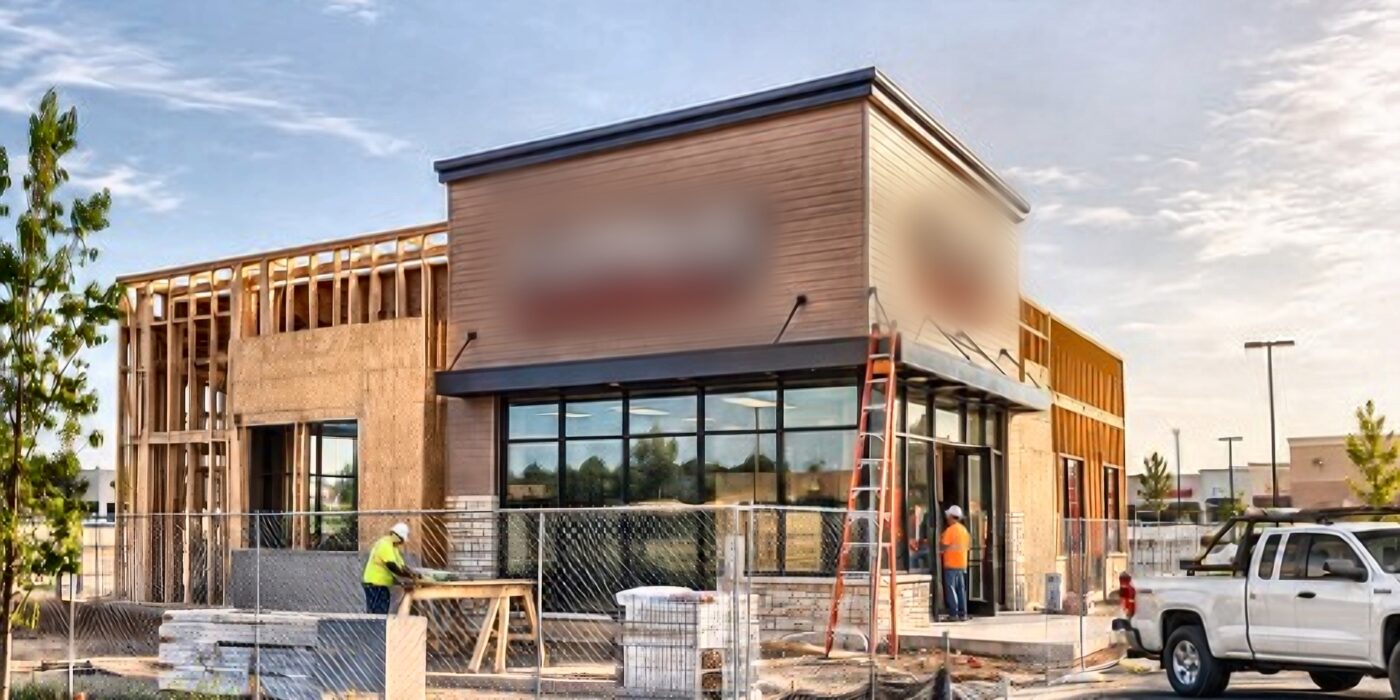
Illustrative construction image with intentionally obscured signage; not a photograph of the project discussed.
Why retail development needs more of an operator’s perspective
Having spent years on both sides of the restaurant business—as an operator and now a real estate developer—I’ve learned that finding a great location is only half the battle.
What you spend to develop that location can be just as important as the location itself.
Recently, LRE & Companies was assisting a future restaurant tenant with entitlements and construction on a new location. We liked the site, believed in the concept, and were looking forward to moving the project ahead. Then the construction bids came back nearly 20% above our original budget.
It’s a situation many development teams know well. Between construction costs, financing expenses, and the challenges of getting projects entitled, the economics can change considerably between the time a deal is negotiated and the time construction is ready to begin.
Everyone wants to open as quickly as possible. The tenant has a schedule, the developer wants to deliver, and nobody wants to lose another month. But is moving ahead immediately always the smartest financial decision?
Sometimes Another 30 Days Makes Sense
In this case, we sat down with our future tenant and discussed whether taking another 30 days to rebid the project, involve additional contractors, and evaluate value engineering opportunities could make more sense than simply accepting the numbers.
Of course, delaying an opening has a cost. It can mean additional carrying expenses and lost sales. But so does spending hundreds of thousands of dollars more than necessary. The right question is whether the potential savings justify the time and risk.
We weren’t suggesting that the tenant compromise the quality of the building, operational efficiency, or the customer experience. We wanted to challenge the costs and see whether there was a better way to deliver the same project.
That’s where my previous life as a restaurant operator comes into play. Instead of looking at a construction overrun only in dollars, we put together a simple matrix: How many additional coffees, burgers, or sandwiches would the restaurant have to sell to recover the extra investment?
It’s amazing how differently people view a construction overrun when it is translated into the additional transactions required to recover it.
What the Extra Investment Really Means
Consider a hypothetical project with a $1.5 million construction budget. If bids arrive 20% above budget, that’s an additional $300,000. The number of extra sales needed to recover that investment depends on the contribution each additional sale generates after its variable costs.
| Incremental contribution per sale | Additional sales to recover $300,000 |
| $2.00 | 150,000 |
| $3.00 | 100,000 |
| $4.00 | 75,000 |
Illustrative capital-recovery calculation only. Contribution means incremental selling price less variable costs. It excludes financing costs, the time value of money, and any required investment return. Actual economics depend on the concept and whether the landlord or tenant funds the improvements.
At $3 of incremental contribution per sale, 100,000 additional sales is approximately 27 extra sales per day over 10 years, assuming the restaurant operates every day. This is a simple recovery illustration, not a full investment-return analysis.
Why Do Some Great Locations Struggle?
It still amazes me when I see national restaurant brands struggle to generate acceptable returns at locations that appear to check every real estate box: excellent visibility, strong traffic counts, favorable demographics, and great access.
Sometimes the challenge is labor, food costs, management, or other controllable operating expenses. But I also wonder how often the problem began long before the doors opened.
Was too much capital invested in building the restaurant in the first place?
A restaurant can produce strong sales and still be a disappointing investment. If the original capital requirement was too high relative to the cash flow a location can generate, even a capable operating team may struggle to deliver the expected return.
Are We Sometimes Overbuilding?
I understand why national brands have standardized building prototypes. Consistency matters. So do building quality, functionality, long-term maintenance, and the guest experience.
But we should be willing to question whether every specification makes economic sense at every location. Site conditions, utilities, local labor availability, and construction practices can differ considerably from one market to another.
Yet some decisions are made from a corporate office, far from the realities of a particular job site or store’s financial performance. That’s not a criticism of corporate development teams; many are excellent at what they do. It’s a reminder that local construction expertise and store-level operating experience deserve a place in the conversation.
Does a design change improve sales or efficiency? Will a more expensive finish meaningfully improve the guest experience? Could we achieve the same objective with a different material, contractor, or construction method?
Value engineering shouldn’t mean building an inferior restaurant. It should mean spending money where it adds value—and questioning costs where it doesn’t.
Site Selection Is More Than Finding the Best Corner
Our years operating restaurants have shaped how we approach development at LRE & Companies. Traffic counts, access, and demographics matter, but so do total project cost, occupancy expense, realistic sales projections, and return on invested capital.
The best corner in town isn’t necessarily the best investment if the numbers don’t support it.
I believe the development process works better when developers understand what happens after the doors open—and when operators understand the challenges of entitlements, construction, and capital costs.
That kind of collaboration can make a difficult conversation today much easier than a disappointing return years from now.
The Right Decision Isn’t Always the Fastest One
Going back to our recent project, the important part of the discussion wasn’t simply the construction bids. It was stepping back with our future tenant to look at the long-term economics before committing to the next step.
A 30-day delay isn’t automatically the right answer. The cost of waiting has to be weighed against the likelihood of savings. But moving ahead simply because everyone wants the store open isn’t always right either.
Having been an operator, I know that the real test begins when the doors open and the store has to perform.
Sometimes the smartest development decision is to slow down long enough to make sure the investment makes sense.
Because a great location is only a great investment when the numbers work.
Akki Patel
Founder & CEO, LRE & Companies
akkipatel.com/blog/ | lrecompanies.com